
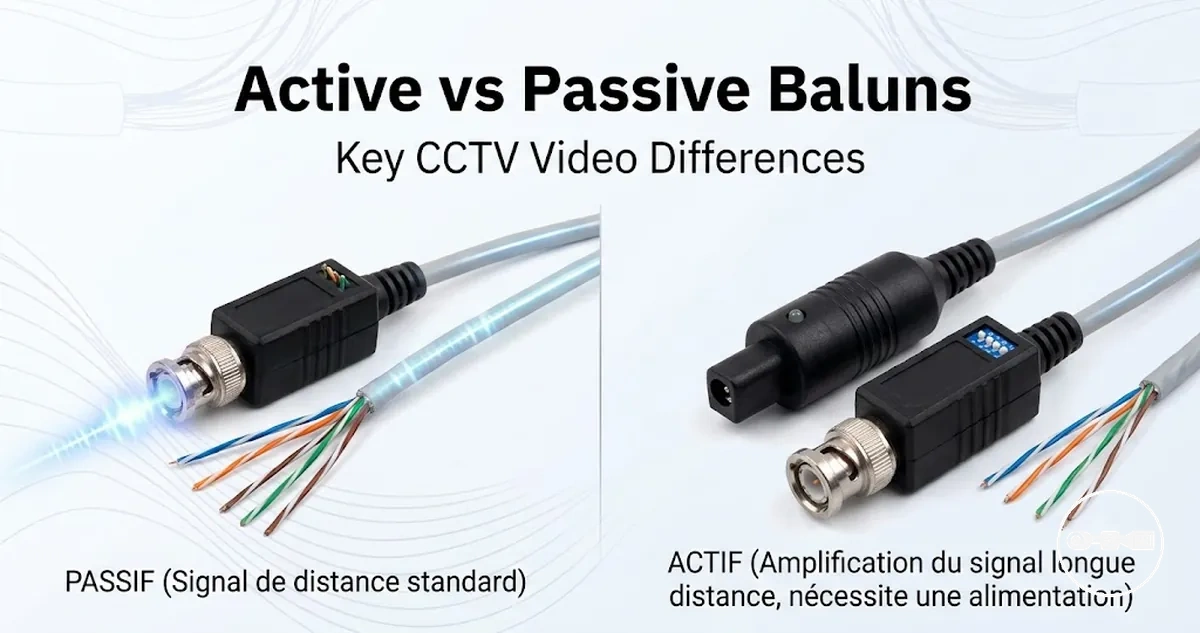
Active vs Passive CCTV Video Baluns: Differences, Distance Limits, Power Requirements and Selection Guide
Active vs passive CCTV video baluns are two signal transmission approaches used in CCTV systems that carry video over UTP cable with BNC connectivity. A CCTV video balun supports signal transfer over structured cabling, while active balun and passive balun differ in how they manage signal behavior, stability, and power requirement. This comparison focuses on practical selection conditions rather than product specifications. The goal is to frame how each option behaves in real CCTV installation environments.
The key evaluation factors include power requirement, signal transmission behavior, distance limits, and signal stability across UTP cable infrastructure. An active balun typically involves a power input that may influence signal conditioning, while a passive balun operates without external power and relies on direct signal transfer characteristics. These differences can affect performance consistency across varying cable lengths and installation conditions. In many CCTV systems, distance limits and environmental interference are central in determining which configuration is more suitable for stable signal transmission.
This section is structured to support decision-making between active balun and passive balun options based on installation context and system requirements. The following comparison will break down how each type responds to distance, interference, and system design constraints. This separation helps clarify where each CCTV video balun type may be more appropriate in structured CCTV system planning.
What Active and Passive CCTV Video Baluns Are and How They Function
A CCTV video balun is a device used to transmit video signals over UTP cable by converting them between BNC and twisted pair connections. Active balun and passive balun represent two functional approaches to this signal conversion process within CCTV systems. The active balun relies on powered circuitry to influence signal handling, while the passive balun operates without external power and depends on the integrity of the transmitted signal. Both are used to support structured signal transmission in different installation conditions.
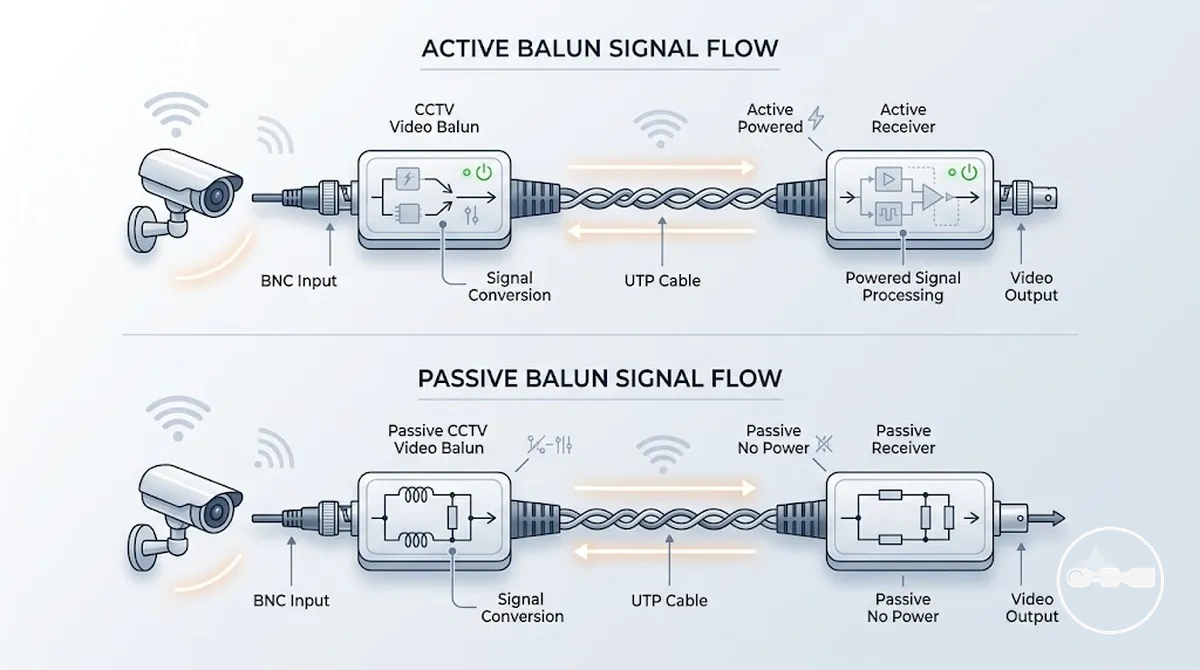
The functional difference between active balun and passive balun is based on how signal conversion and transmission behavior are managed across UTP cable infrastructure. Active baluns introduce powered signal processing that may influence stability under certain conditions, while passive baluns maintain a direct conversion approach without amplification. These differences shape how signal transmission responds to distance limits and installation environments, and how baluns transmit video helps clarify this conversion process.
- Active balun: Uses power input to support signal conditioning during transmission.
- Passive balun: Relies on direct signal conversion without external power.
- Signal behavior: Varies depending on cable quality and transmission conditions.
- Transmission outcome: Affected by conversion method and UTP cable characteristics.
Key Differences Between Active and Passive CCTV Video Baluns
The key difference between active CCTV balun and passive CCTV balun is how signal amplification and power influence transmission behavior. Active CCTV balun systems rely on powered processing that can shape signal strength during transmission, while passive CCTV balun systems depend on direct signal conversion without amplification. This difference affects how each type responds to UTP cable conditions and installation environments. It also changes how signal stability is maintained across different distances. As a result, the distinction is primarily driven by power involvement and signal handling approach rather than basic connectivity.
The structured comparison below highlights how active CCTV balun and passive CCTV balun differ across amplification, signal stability, distance tolerance, and installation simplicity. The table provides a clear separation of functional differences between the two approaches.
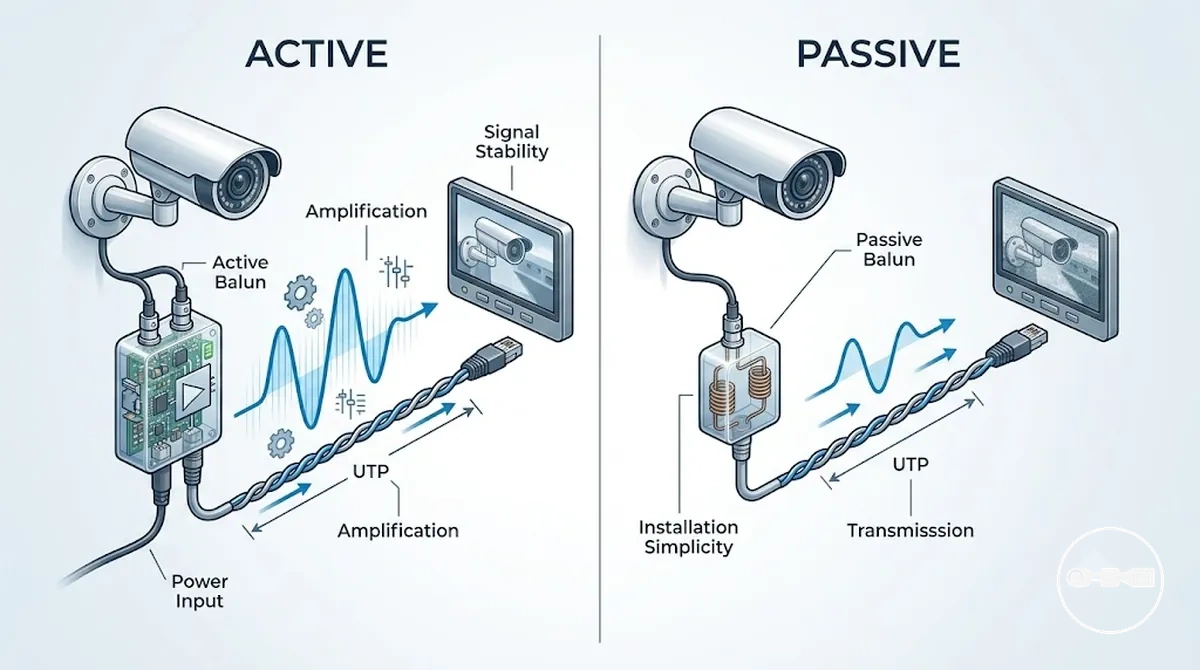
Active systems typically emphasize amplification-driven stability under extended transmission conditions, while passive systems emphasize simplicity with direct conversion behavior. Signal stability in active designs may improve under certain conditions due to powered processing, while passive designs rely more directly on cable quality and inherent signal integrity. Installation simplicity is generally higher in passive configurations due to the absence of power requirements, while active configurations involve additional powered components that may affect deployment design. Neither approach guarantees uniform performance across all CCTV systems, as outcomes depend on UTP cable quality and system layout.
| Factor | Active CCTV Balun | Passive CCTV Balun |
|---|---|---|
| Power | Requires external power input | No external power required |
| Signal behavior | Uses amplification-based processing | Relies on direct signal conversion |
| Distance tolerance | May support longer runs depending on setup | Typically more limited by cable conditions |
| Complexity | Higher due to powered components | Simpler installation with fewer components |
Choosing between active CCTV balun and passive CCTV balun depends on balancing signal stability needs against installation simplicity. Active configurations are often selected when amplification-based support is required for more demanding transmission conditions, while passive configurations are preferred when simpler deployment is a priority. Performance differences remain conditional on system design and cable infrastructure, rather than fixed outcomes. The decision is typically guided by how each system aligns with overall CCTV installation requirements.
Power Requirements, Signal Amplification and Loss Behavior
Power supply determines whether signal amplification is possible in a CCTV video balun system and directly shapes how signal loss is managed during transmission. In an active balun setup, the power supply enables internal processing that can influence signal conditioning before transmission through the UTP cable. In a passive balun setup, the absence of external power means the system relies entirely on raw signal transfer without reinforcement. This creates a direct dependency between available power and whether signal amplification can occur. As a result, power availability defines the boundary between enhanced processing and unmodified signal flow.
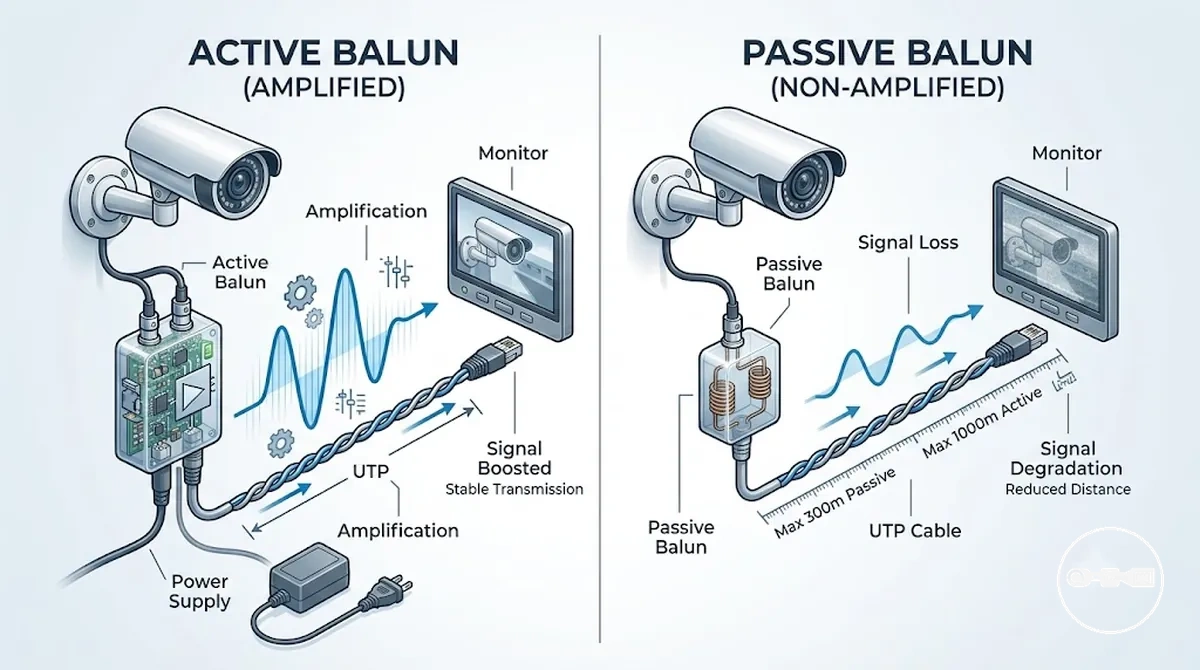
When amplification is supported by a powered active balun, signal reinforcement can be applied before transmission, which may reduce the impact of signal loss under certain conditions. This process depends on consistent power supply, which enables controlled signal conditioning inside the active balun. In contrast, a passive balun does not include amplification capability, so signal loss is handled without enhancement and follows the natural degradation of the transmission path. This establishes a clear chain: power input enables amplification, amplification influences signal stability, and absence of power results in direct loss behavior. The difference is therefore defined by whether the system can actively modify the signal or only pass it through unchanged.
- Power supply: Enables signal processing and amplification in active balun systems.
- Active balun: Uses powered circuitry to reduce or manage signal loss.
- Passive balun: Relies on direct transmission without signal reinforcement.
- Amplification: Present only when external power is available.
- Signal loss: More directly visible in passive systems due to lack of conditioning.
Signal loss, noise immunity and transmission stability differences
Signal loss in CCTV video balun systems is influenced by attenuation and interference that occur during real installation conditions such as extended cable runs and exposure to electrical noise sources. Attenuation gradually reduces signal strength as distance increases, while interference introduces external noise that can distort the transmission path. These two degradation factors affect how consistently the signal arrives at the receiver under practical deployment conditions. As a result, transmission stability depends on how the system responds to both progressive weakening and external disturbance. Signal stability is therefore shaped by environmental exposure rather than a single fixed condition.
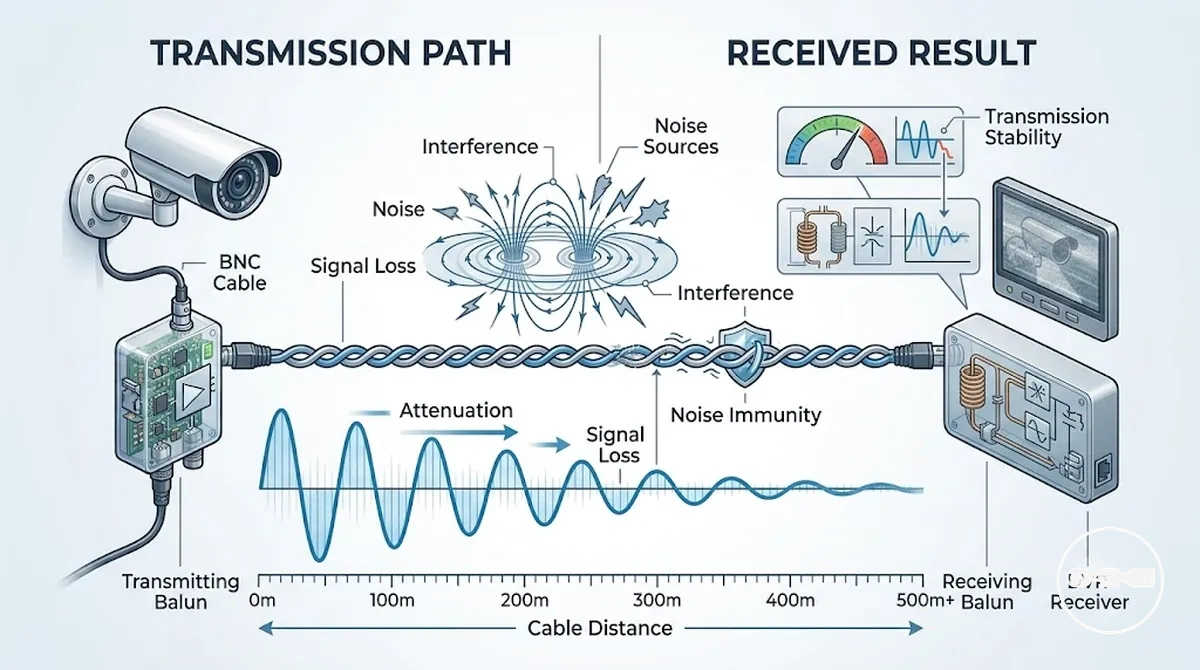
Noise immunity and transmission stability vary between active and passive CCTV video balun systems depending on how each handles attenuation and interference. Active systems may provide improved noise immunity through signal conditioning, which can help maintain more consistent transmission stability under certain conditions. Passive systems rely more directly on incoming signal strength, making them more sensitive to attenuation over distance and more exposed to interference effects. In both cases, transmission stability is an outcome of how effectively signal loss and noise are managed within the installation environment. Differences in stability therefore reflect variation in resistance to degradation factors rather than fixed performance behavior.
| Cause | Effect | System Impact |
|---|---|---|
| Attenuation | Gradual signal weakening over distance | Reduced transmission stability |
| Interference | External noise distortion | Lower noise immunity and variable output quality |
| Long cable runs | Increased signal loss exposure | Greater dependency on system handling capability |
Installation complexity and system design implications
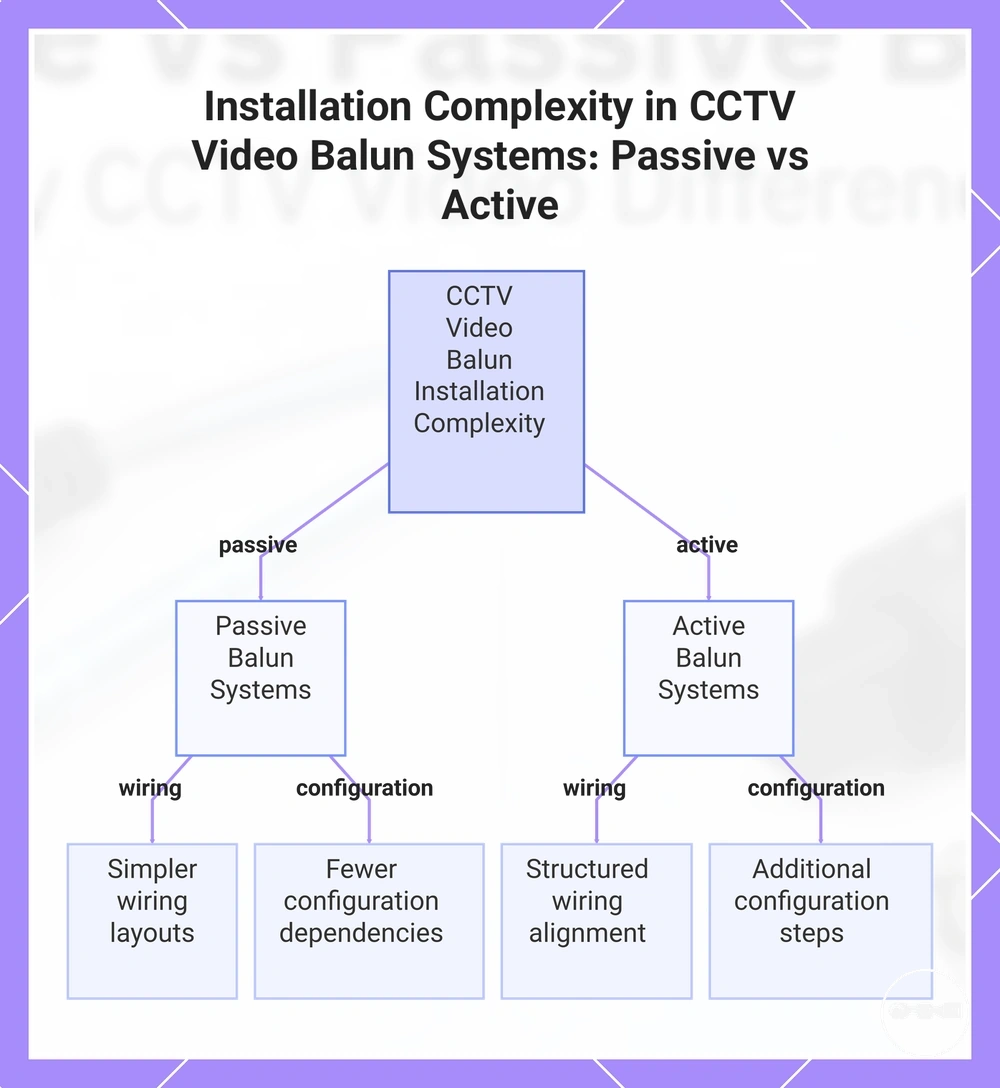
Installation complexity in CCTV video balun systems is driven by system type, where active balun and passive balun designs create different wiring and configuration demands. Passive setups typically reduce installation complexity by relying on simpler wiring structures and fewer configuration dependencies during system design. Active balun systems introduce additional configuration considerations that can increase deployment effort depending on the overall design. These differences shape how installation complexity is evaluated in terms of wiring structure, setup requirements, and system integration. As a result, system type directly influences deployment effort within the broader design framework.
From a design perspective, wiring and configuration define how installation complexity is distributed between system types. Passive balun implementations often support more straightforward wiring layouts, which can lower setup requirements in less demanding installations. Active balun configurations may require more structured wiring alignment and additional configuration steps, which can increase design coordination effort. These factors do not define performance but instead affect how system deployment is planned and organized. Therefore, installation complexity reflects the relationship between wiring demands, configuration needs, and overall system design choices.
- Wiring: Passive balun systems generally require simpler wiring layouts compared to active system designs.
- Configuration: Active balun systems may introduce additional configuration requirements during setup.
- System design: Complexity increases when wiring structure and configuration dependencies expand.
This chart compares how passive and active balun system designs influence installation complexity through wiring and configuration requirements.
Distance Limits and Signal Performance in CCTV Video Transmission
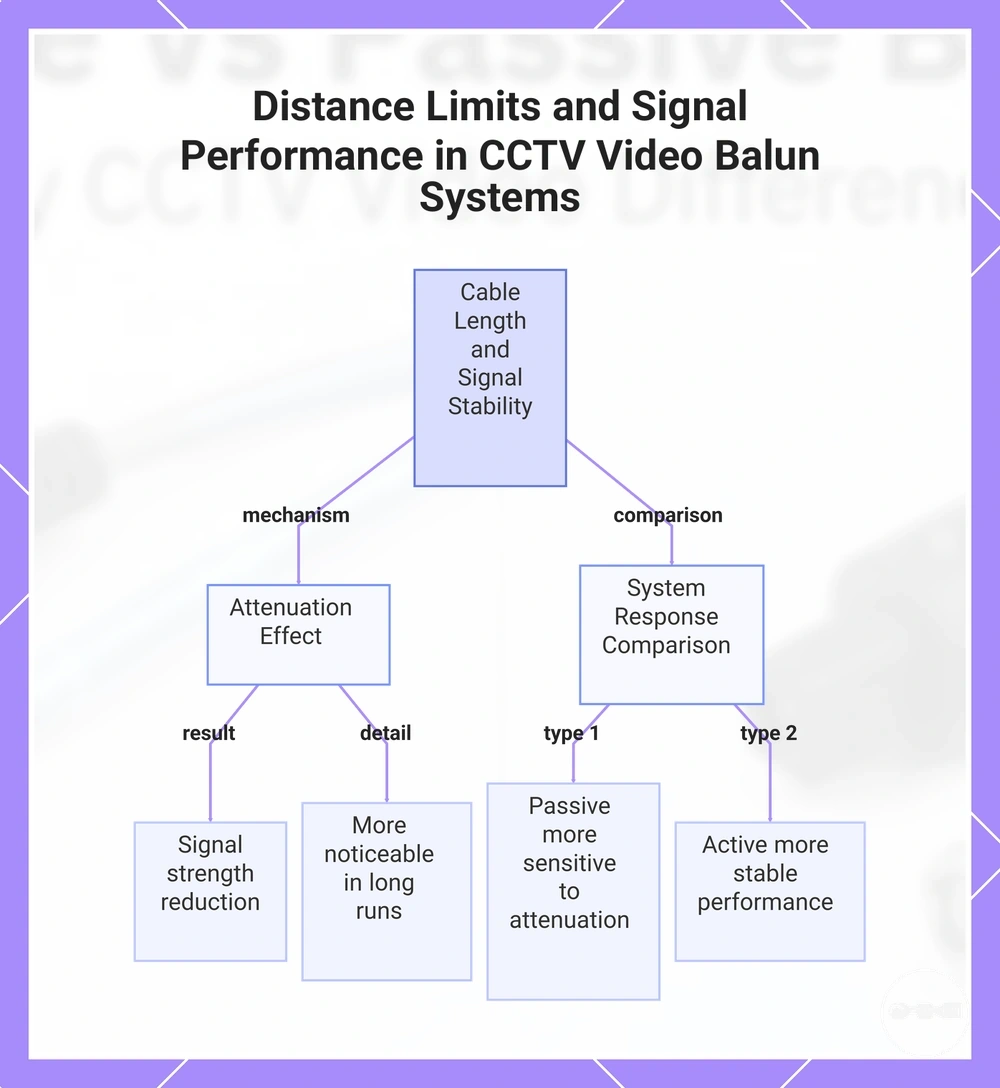
Distance limits are a key constraint in CCTV video balun system design, where cable length directly influences signal stability during transmission. As cable length increases, the CCTV video balun becomes more sensitive to attenuation effects that reduce consistent signal delivery. This makes distance a primary evaluation factor when selecting between system types, especially in structured video transmission setups. In practical conditions, longer cable length often introduces greater variability in signal stability depending on environmental and installation conditions.
As cable length increases, attenuation gradually reduces signal strength along the transmission path, affecting how reliably video data reaches the receiver. This loss behavior becomes more noticeable in extended runs where the cumulative impact of distance limits is higher. Signal stability is therefore shaped by both the CCTV video balun design and how effectively the system manages distance-driven degradation. In many real-world installations, performance differences become more visible as the system approaches higher cable length thresholds.
When comparing system behavior under different distance conditions, passive systems tend to show higher sensitivity to attenuation over longer cable runs, while active systems may maintain more stable performance depending on design conditions. This distinction helps define how CCTV video balun systems respond to distance stress in transmission environments. For related constraints on structured wiring compatibility, see distance and cable limits, which explains how cable type influences performance outcomes in relation to cable length and attenuation behavior.
This chart explains how cable length impacts signal stability through attenuation and compares the behavior of passive and active systems under distance stress.
Passive CCTV video balun distance limitations and degradation risks
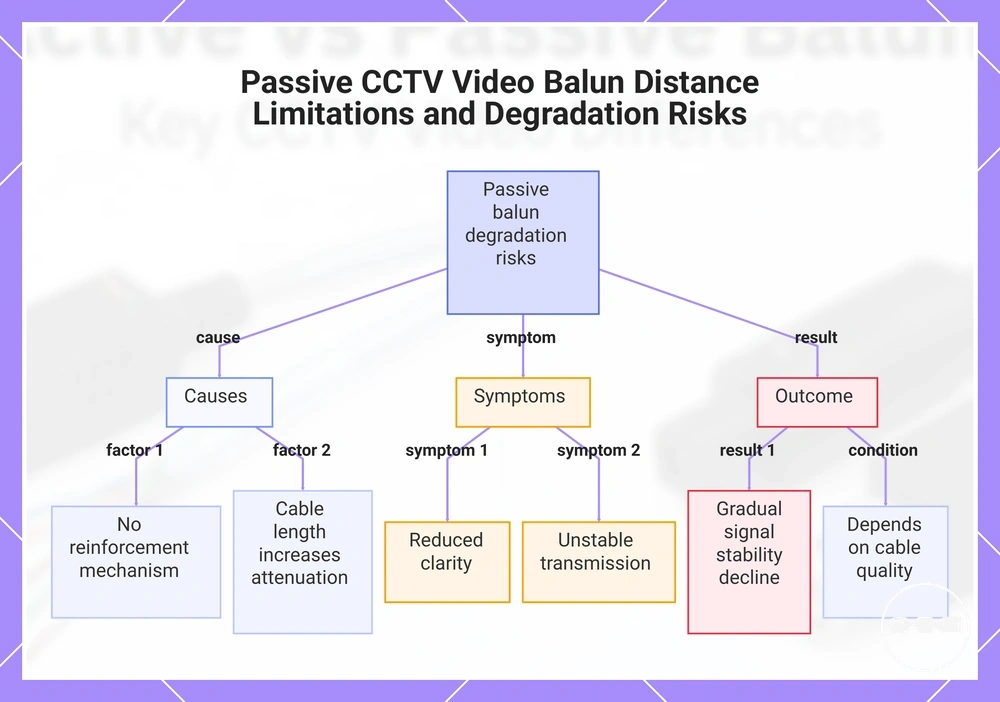
Passive CCTV video balun systems evaluate higher risk of signal degradation as cable length increases because they do not include any reinforcement mechanism. The passive balun design relies on direct transmission, which makes attenuation effects more visible over longer runs. As distance grows, cable length becomes a stronger factor in reducing signal stability due to gradual loss of energy in the transmission path. This creates a direct relationship between distance limits and the likelihood of performance decline in structured CCTV video balun setups. :contentReference[oaicite:0]{index=0}
The absence of amplification in a passive balun increases sensitivity to attenuation and makes the system more exposed to noise interference in real installation conditions. Over extended cable length, signal degradation may appear as reduced clarity or unstable transmission behavior depending on environmental factors. These risks do not follow fixed thresholds but tend to increase as distance and external interference grow. The outcome is typically a gradual decline in signal stability rather than an immediate failure, depending on system design and cable quality.
- Increased attenuation impact: Signal strength reduces more noticeably as cable length increases.
- Noise interference sensitivity: External electrical noise can more easily distort transmission quality.
- Progressive signal degradation: Video stability may decline gradually over extended runs.
- Reduced transmission stability: Overall consistency may vary depending on installation conditions.
This chart shows the causes, observable symptoms, and eventual outcome of signal degradation in passive CCTV video baluns over long cable runs.
Long-distance performance advantages of active CCTV video baluns
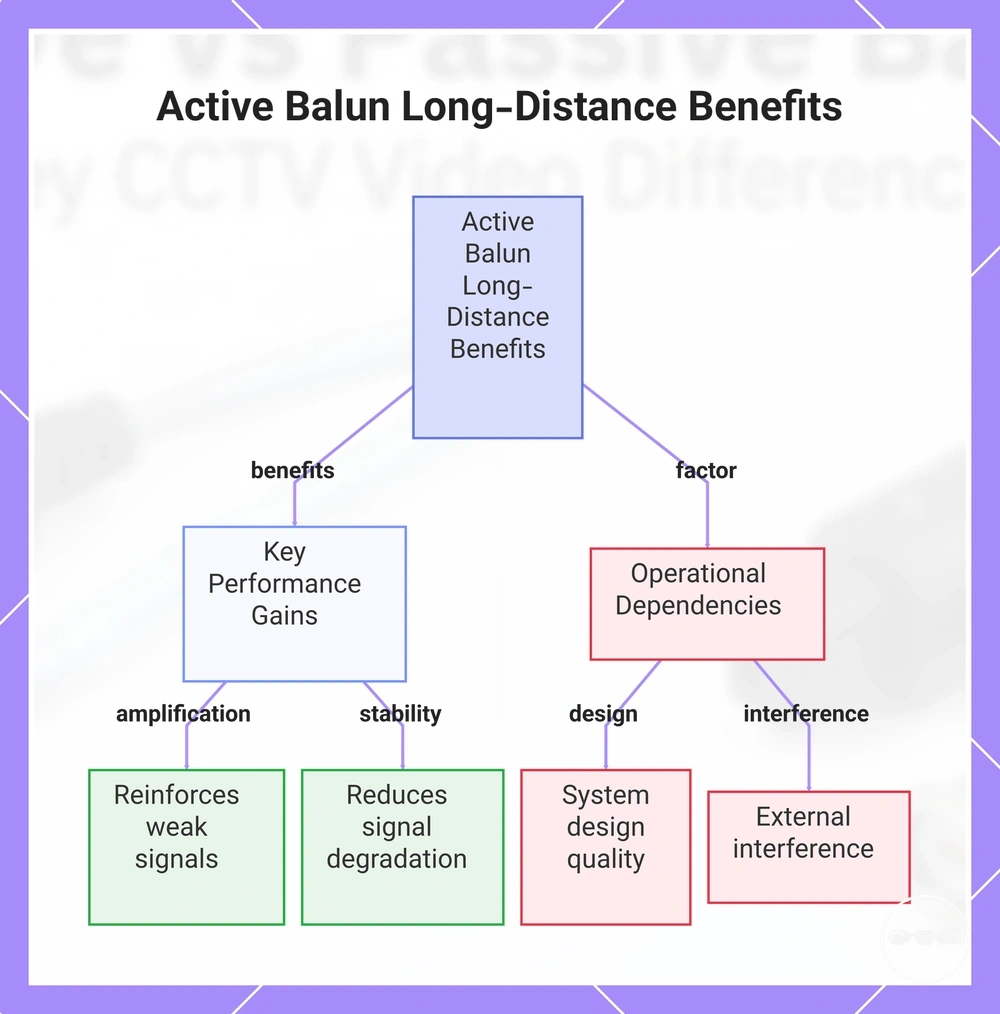
An active balun can enhance long-distance signal transmission by using internal signal amplification to support more stable delivery over extended cable runs. In CCTV video transmission, long-distance conditions often introduce attenuation that reduces overall signal clarity, and active circuitry may help reduce the impact of this loss. This improvement is typically dependent on system design and installation conditions, where the active balun works to maintain usable signal levels rather than fully eliminating degradation. As a result, long-distance performance is often more stable compared to non-amplified approaches, depending on environmental and cable factors.
Through signal amplification and conditioning, an active balun may improve stability by reinforcing weakened signals before they degrade further along the transmission path. This can help reduce the effects of attenuation and support more consistent signal stability in longer cable length scenarios. The benefit is not absolute and can vary based on system quality and external interference conditions, but the reinforcement mechanism is designed to improve overall long-distance behavior.
- Signal amplification: Helps reinforce weakened signals during long-distance transmission.
- Attenuation reduction: May reduce the visible impact of signal loss over extended cable runs.
- Stability improvement: Can support more consistent video output under longer transmission paths.
- Distance handling: Performs more effectively in scenarios with increased cable length demands.
This chart shows the key performance benefits of active CCTV video baluns for long-distance transmission and the operational dependencies that affect these benefits.
When to Use Active or Passive CCTV Video Baluns
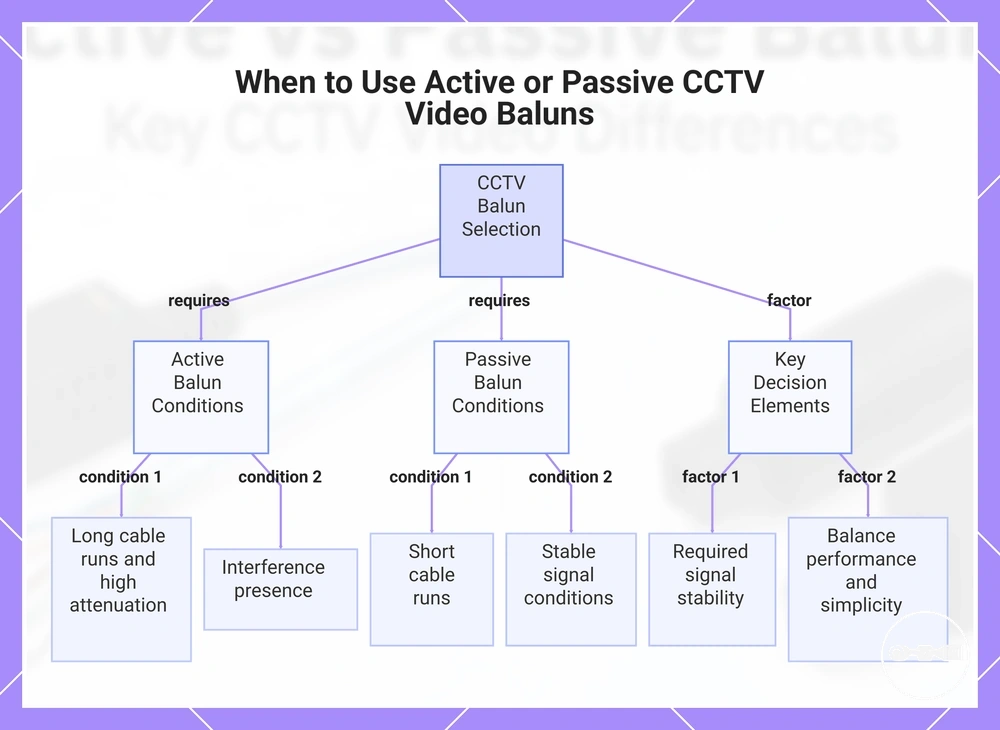
The selection of active balun or passive balun in a CCTV system depends on deployment conditions such as distance, interference levels, and system complexity. The selection criteria are evaluated based on how the CCTV system behaves under specific environmental and installation constraints rather than fixed rules. In practice, the decision focuses on matching transmission requirements with expected signal conditions. This makes the selection process condition-driven and dependent on real-world setup factors.
Distance requirements, interference exposure, and installation complexity form the main selection criteria for choosing between active balun and passive balun solutions. Longer cable length and higher attenuation conditions may require active signal handling, while shorter runs with lower interference may be suitable for passive configurations. When interference levels increase, maintaining signal stability becomes more critical, often shifting preference toward active solutions. Simpler CCTV system layouts with reduced complexity typically align with passive setups when transmission conditions remain stable.
Decision-making in CCTV system design is based on evaluating operating conditions against required signal stability, where distance and interference are prioritized before system complexity. The final selection depends on balancing performance needs with installation practicality, ensuring the chosen balun type fits the environment. For structured guidance on evaluation steps, users can choose the right CCTV video balun based on defined selection logic. This approach ensures alignment between system requirements and real deployment conditions.
- Choose active balun when: cable length is long, attenuation risk is higher, or interference is present.
- Choose passive balun when: cable runs are short and signal conditions are stable.
- Key factor: required signal stability under real CCTV system conditions.
- System consideration: balance between performance needs and installation simplicity.
This chart shows the key conditions and factors for choosing between active and passive CCTV video baluns based on distance, interference, and system complexity.
Short-distance CCTV installations and simple wiring setups
Passive balun is suitable for short distance CCTV setup where low interference and simple wiring conditions allow direct signal transmission without additional processing. In a CCTV setup with short distance runs, signal degradation remains minimal, which supports stable performance using a passive balun. This makes it appropriate for environments where installation simplicity is prioritized over extended transmission handling. :contentReference[oaicite:0]{index=0}
The suitability of passive balun in these conditions depends on short distance routing, low interference levels, and reduced system complexity. When simple wiring is used, installation becomes easier and reduces configuration requirements within the CCTV setup. Low interference environments further support stable signal flow, allowing minimal loss during transmission. In this context, passive balun selection aligns with scenarios where system demands remain basic and controlled.
- Short distance: Limited cable length reduces attenuation impact.
- Low interference: Minimal noise supports stable transmission.
- Simple wiring: Reduces installation complexity and setup effort.
- CCTV setup stability: Works well when system conditions remain controlled.
Long-distance CCTV runs requiring stable signal transmission
Long-distance CCTV runs depend on signal stability requirements, so active balun is typically preferred in CCTV installation scenarios where attenuation risk increases over extended cable lengths. In these conditions, an active balun may support more consistent signal stability when attenuation begins to affect transmission quality over distance. Long-distance setups often depend on how well the system manages signal degradation across the CCTV installation, especially when cable constraints increase. In such cases, system evaluation is often linked to cable and distance limits, which influence how transmission performance behaves under extended runs.
The selection rationale is based on extended runs leading to higher attenuation, which can reduce signal stability if no reinforcement is applied. An active balun addresses this by supporting signal conditioning that may help reduce the impact of attenuation across longer transmission paths. As cable length increases, the risk of signal loss becomes more significant, making stability a key requirement in CCTV installation design. This is why amplification-based handling is often considered when maintaining consistent output over distance is the priority. In these conditions, performance expectations depend on installation quality and environmental factors rather than fixed behavior.
High-interference environments and signal stability requirements
High-interference environments affect signal transmission by introducing environmental noise that increases disruption risk and reduces overall signal stability in a CCTV system. In these conditions, interference from electrical sources or nearby equipment can weaken clarity and make consistent transmission more difficult to maintain. This raises the importance of noise immunity as a key factor when evaluating system performance under stress conditions. An active balun may be preferred in some cases because signal conditioning can help support more stable behavior, while a passive balun can be more sensitive to environmental interference depending on installation conditions. The overall selection depends on how effectively the system maintains signal stability in noisy environments. :contentReference[oaicite:0]{index=0}
Selection decisions in high-interference scenarios focus on balancing interference intensity, required signal stability, and the level of noise immunity needed for reliable CCTV system operation. Interference is treated as a separate factor from distance to preserve clear decision logic, since environmental noise affects transmission differently than attenuation-based loss. In high-interference setups, active balun solutions are often evaluated for their ability to support more stable output, while passive balun options may be more suitable in low-interference environments where signal conditions remain cleaner. Contrast checklist: high-interference environments typically require stronger noise immunity and stability focus, while low-interference environments often allow simpler transmission conditions with reduced stabilization needs. This distinction helps guide selection based on environmental conditions rather than structural wiring factors alone.
Compatibility with CCTV Cameras, Recorders and Cable Types
Compatibility defines how a CCTV video balun ensures correct integration between a CCTV camera, recorder, and cable type within a unified transmission chain. The CCTV video balun acts as an interface component that aligns signal transfer between camera output and recorder input to maintain system-level interoperability. When compatibility is correctly established, signal integrity remains consistent across connected devices, while mismatches may introduce signal distortion or reduced stability. This makes compatibility a structural requirement for CCTV system integration rather than a single-device characteristic.
Compatibility depends on alignment between device connector standards, signal formats, and cable type selection within the CCTV installation. A CCTV video balun must match the CCTV camera output specification and the recorder input requirement to ensure stable signal conversion across the transmission path. Differences in cable type can influence signal integrity and system performance, especially when transmission distance or environmental factors increase. For structured system alignment and cable constraints, see distance and cable limits, which explains how cable type impacts interoperability requirements in CCTV setups.
System compatibility is determined by evaluating how each device behaves within the full transmission chain, ensuring that the CCTV camera, recorder, and cable type operate cohesively through the CCTV video balun. The balun functions as the central integrator that supports signal continuity across different hardware standards while maintaining expected signal outcomes. When all components align, signal stability is typically more consistent, although installation conditions may still influence performance variation.
| Device | Attribute | Compatibility Result |
|---|---|---|
| CCTV camera | Signal output standard | Must align with balun input for stable transmission |
| Recorder | Input decoding format | Requires matched signal conversion for correct reception |
| Cable type | Transmission characteristics | Influences signal stability and system integration quality |
:contentReference[oaicite:0]{index=0}
Cost, Value and Deployment Considerations for Active vs Passive Baluns
Cost value in CCTV system design depends on balancing performance requirements against deployment constraints when selecting an active balun or a passive balun. The decision is shaped by how much installation effort is acceptable relative to expected signal performance, since an active balun is evaluated where additional signal handling is required while a passive balun suits simpler deployment scenarios. This makes cost value a function of system complexity rather than a fixed purchase consideration. Deployment conditions therefore define how each option is justified within the overall CCTV video balun setup.
The trade-off between active balun and passive balun is mainly driven by investment level, performance benefit, and installation effort across different CCTV deployment scenarios. Active balun typically involves higher system complexity due to added signal processing needs, which increases installation effort in structured environments. Passive balun reduces system complexity and may also limit performance consistency in simpler cable layouts. The cost value equation therefore shifts depending on whether stability over distance or simplicity in deployment is prioritized. Scalability also becomes relevant, as larger installations may require additional balancing of investment, performance, and system design cost factors.
From a decision perspective, cost value should be evaluated based on how well the selected balun aligns with system design goals and operational stability needs. Active balun solutions may justify higher installation effort when signal stability is critical, while passive balun configurations may be preferred when simplicity and reduced deployment complexity are primary goals. The final choice depends on matching system requirements with acceptable trade-offs in performance and integration effort. This ensures that cost value reflects long-term system behavior rather than only initial deployment conditions.
| Factor | Active Balun | Passive Balun | Use Case Implication |
|---|---|---|---|
| Cost | Higher system investment level | Lower system investment level | Depends on deployment scale and requirements |
| Complexity | Higher integration and installation effort | Simpler deployment structure | Affects overall installation effort |
| Performance | Supports stronger signal stability needs | Suitable for basic transmission conditions | Determines reliability under system load |
| Use case | Stability-focused deployments | Simplicity-focused deployments | Defined by CCTV system requirements |