

CCTV Video Balun Meaning and Its Role in CCTV Signal Transmission Systems
A CCTV video balun is a signal interface device used in CCTV signal transmission that connects coaxial cable (BNC) systems with UTP cable infrastructure. It enables signal conversion and impedance matching to maintain stable video signal transfer across different cabling types, ensuring the CCTV system can carry a consistent video signal under varying installation conditions. In many setups, it is used to extend transmission distance and support more flexible cabling layouts.
It fits into a CCTV system as a bridging component between the CCTV camera and the recording device, allowing the video signal to move from coaxial-based output into a UTP cable pathway. This adaptation helps maintain signal transmission stability while aligning different cabling standards within the same CCTV infrastructure. Depending on installation quality and cable conditions, it supports more flexible system design where distance or routing constraints exist. The CCTV video balun therefore acts as a functional link in the overall signal transmission chain and prepares the foundation for more detailed operational and comparison-based sections.
What a CCTV Video Balun Is and How It Converts CCTV Signals Between Cable Types
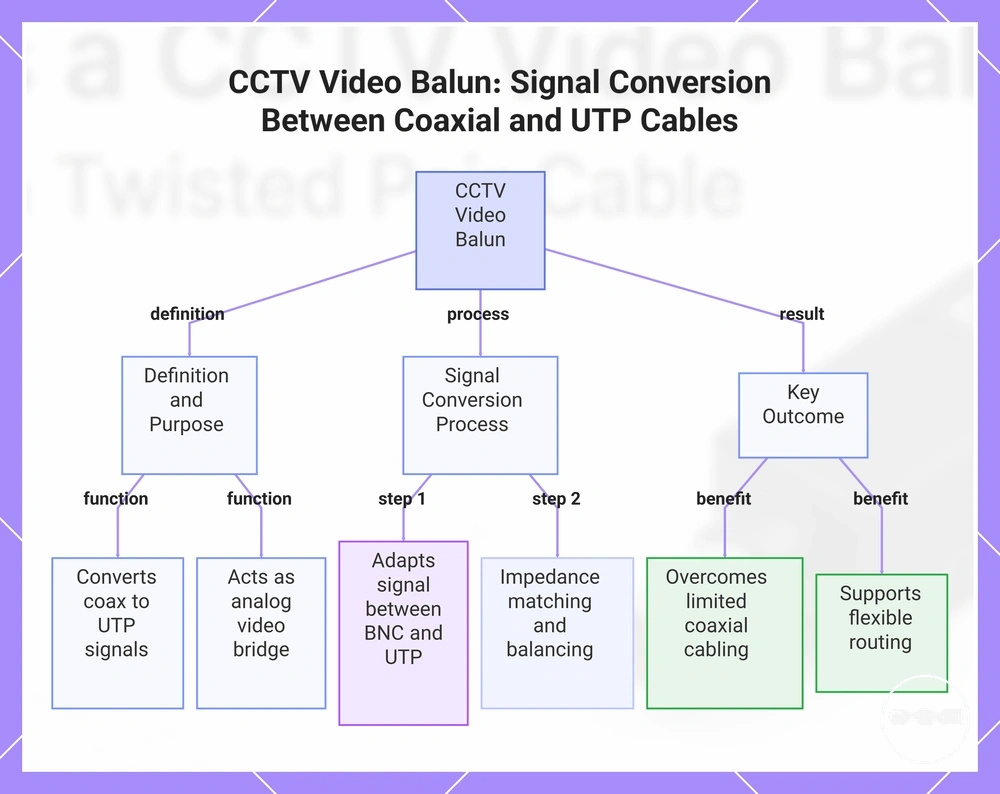
A CCTV video balun is a device that enables signal conversion between coaxial cable systems and UTP cable infrastructure in CCTV signal transmission, supporting compatibility between different cabling formats. It acts as a bridge for analog video signal transfer and is commonly used in CCTV system setups where CCTV video baluns guide infrastructure is involved to maintain stable transmission across mixed cable types.
The CCTV video balun works by adapting the video signal between a BNC connector-based coaxial output and twisted pair UTP cable, allowing the same CCTV video signal to travel across different physical media. This process involves impedance matching and balanced-to-unbalanced signal transformation, which helps reduce mismatch issues during transmission. In many CCTV system layouts, this function supports more consistent video signal behavior when cable types or distances vary, depending on installation quality and cable conditions.
For example, a CCTV camera using a BNC connector output can be connected through a CCTV video balun to a UTP cable run, which then carries the analog video signal toward a DVR. At the receiving end, another balun may convert the signal back for DVR compatibility, enabling end-to-end transmission over mixed cabling. This setup allows flexible routing in CCTV installations where direct coaxial cabling may be limited or less practical.
This chart defines a CCTV video balun, explains its signal conversion process, and highlights the key benefit of flexible installation routing.
What Does a CCTV Video Balun Do in Practical CCTV Camera Installations
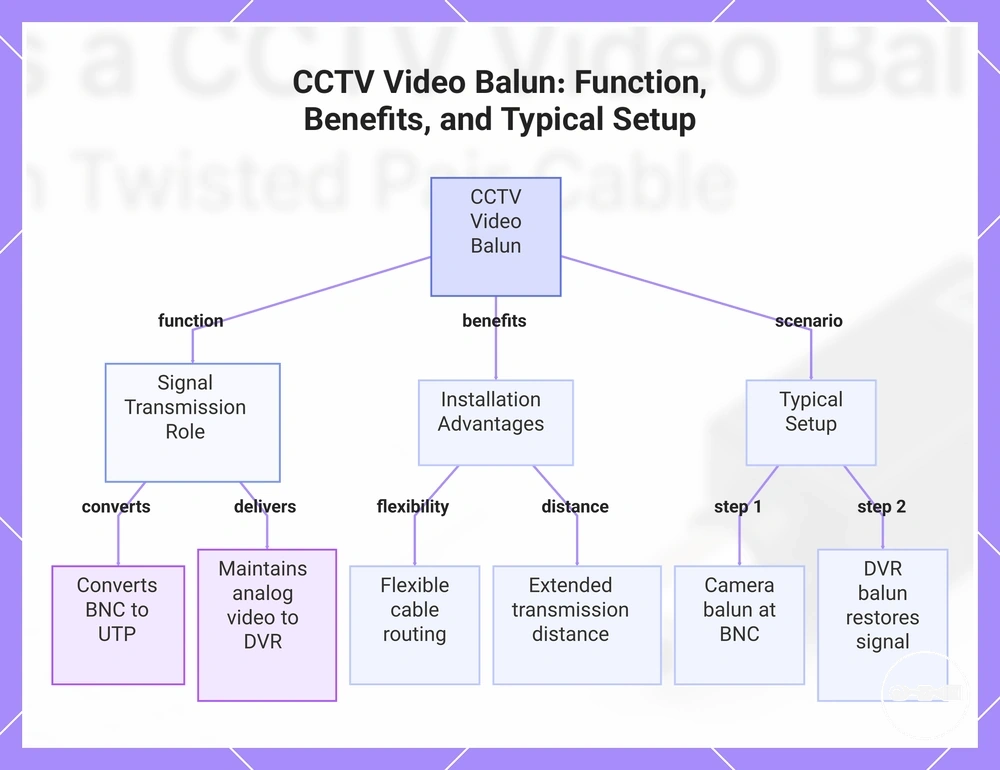
A CCTV video balun is used in practical CCTV camera installations to enable video signal transmission over UTP cable instead of relying only on coaxial cable. It supports installation flexibility by allowing CCTV camera connections to integrate with different cabling layouts while maintaining CCTV video signal delivery to a DVR. In many setups, it also helps extend transmission distance depending on cable quality and overall system conditions.
In a typical installation scenario, a CCTV camera located at a building corner may output its video through a BNC connector connected to a CCTV video balun. The signal is then carried through a UTP cable run across longer routing paths where coaxial cable may be difficult to install. At the other end, another balun connects the UTP line back to the DVR, allowing the analog video signal to be received and recorded. This setup is commonly used in CCTV systems where flexible cable routing and extended transmission distance are required under practical site constraints.
This chart shows the core function, installation advantages, and typical setup of a CCTV video balun in practical camera installations.
How CCTV Video Baluns Transmit Video Over UTP and Twisted Pair Cabling
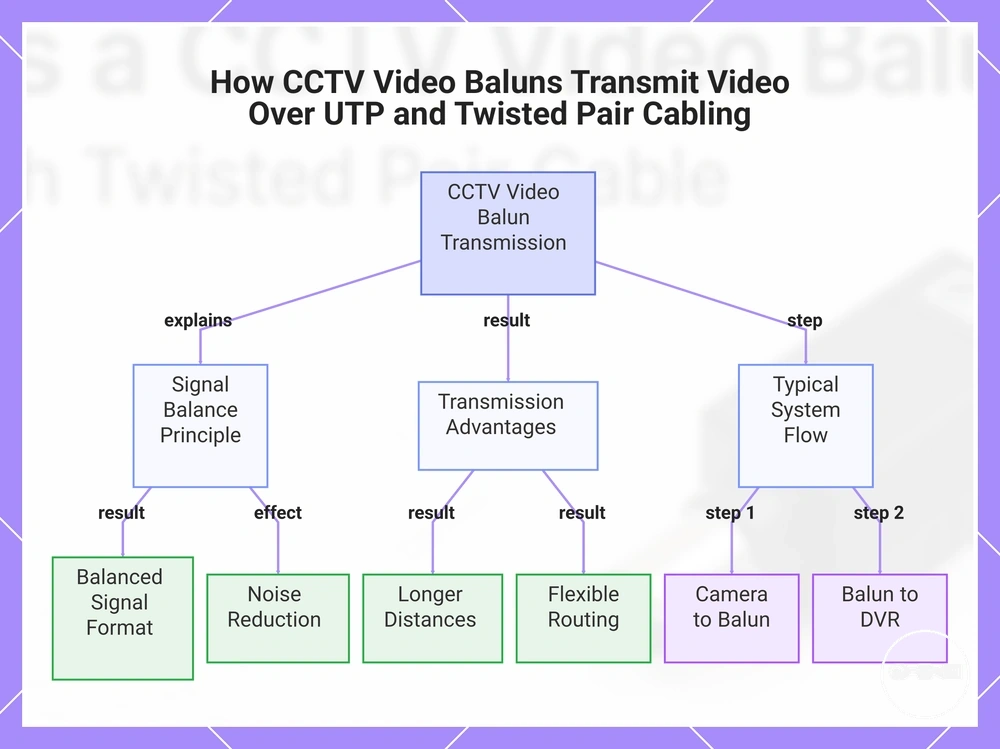
A CCTV video balun enables CCTV video transmission over twisted pair cable and UTP by converting the signal into a balanced format suitable for structured cabling runs. This supports stable CCTV video delivery across longer distances where coaxial cable alone may be limited.
The transmission process is based on signal balance, where the CCTV video balun aligns the electrical characteristics of the twisted pair cable to improve compatibility with analog CCTV video signals. This signal balance supports noise reduction by reducing interference that can affect transmission over UTP cabling, which can vary depending on installation conditions and cable quality. As a result, transmission stability may improve in many CCTV system layouts, especially when distance and routing complexity increase. In EAV terms, the cable type (UTP / twisted pair cable) influences signal behavior (balance and interference handling), which directly affects CCTV video transmission stability. These behaviors are often considered alongside how CCTV video baluns work and UTP cable requirements when evaluating structured cabling design.
In a simple flow example, a CCTV camera sends its video signal through a UTP-based connection using a CCTV video balun instead of direct coaxial transmission. The signal travels through twisted pair cabling to the recording system, where another balun restores compatibility for the DVR input. This setup allows CCTV video transmission with more flexible routing while maintaining usable stability in typical installation environments.
This chart shows how a CCTV video balun transmits video over UTP and twisted pair cabling, including the signal balance principle, transmission advantages, and a typical system flow.
Why CCTV Video Baluns Are Used Instead of Coaxial Cable in CCTV Systems
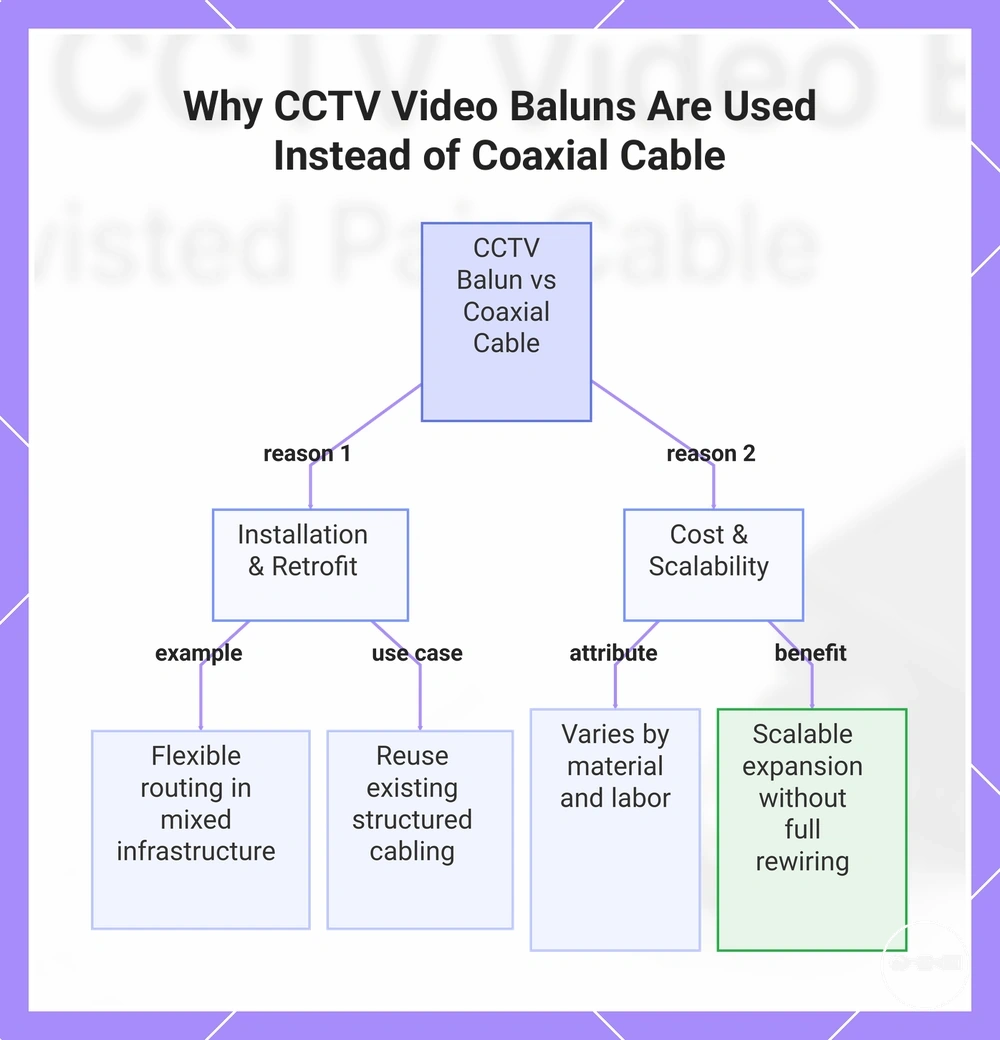
CCTV system designs may use balun-based UTP cable instead of coaxial cable depending on installation flexibility, retrofit requirements, transmission distance needs, and cost efficiency. The choice is typically driven by how existing infrastructure can support expansion or adaptation without major rewiring.
The decision between coaxial cable and UTP cable in a CCTV system depends on installation context rather than a universal preference. Coaxial cable is often used in direct, traditional layouts, while UTP cable with a balun interface can support retrofit projects where existing structured cabling is reused or extended. Installation flexibility may be higher when routing constraints or mixed infrastructure are present, while cost efficiency can vary based on material use and labor requirements. For system expansion scenarios, balun-based setups may support more scalable configurations without requiring full cable replacement. These considerations are often evaluated alongside active and passive balun types when selecting an appropriate CCTV system design approach.
This chart explains the key decision factors for choosing balun-based UTP cable over coaxial cable, including installation context and cost scalability.
CCTV Balun vs Coax: Key Differences in Signal Handling and Installation
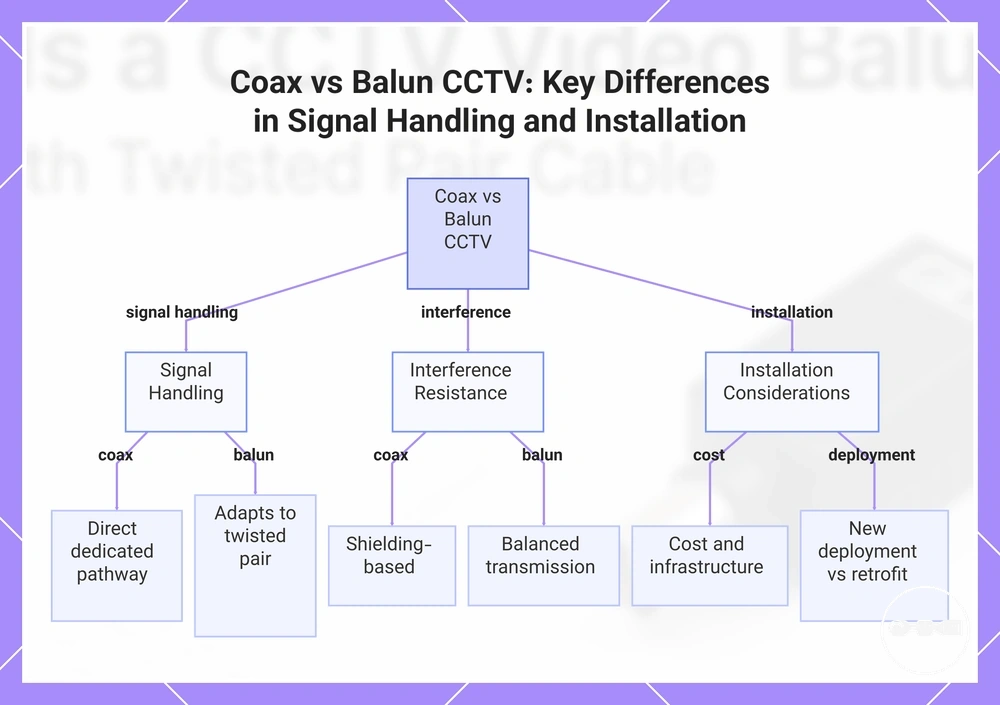
CCTV video transmission compares two main approaches: coaxial cable and balun-based UTP cable, each handling signal behavior and installation requirements differently. The choice between them depends on how a CCTV system is designed for signal handling, interference control, and installation conditions.
Coaxial cable supports direct CCTV video signal handling with a single dedicated pathway, which can provide predictable behavior in stable installations but may be less flexible when system layouts change. Balun-based UTP transmission adapts the CCTV video signal for twisted pair environments, which can improve installation flexibility, especially in retrofit projects where existing infrastructure is reused. Interference resistance differs depending on environment and cable quality, with coaxial cable relying on shielding and balun setups relying on balanced transmission characteristics. In terms of distance and performance, both approaches may support CCTV video transmission, but results vary based on installation quality, cable type, and system design. Installation decisions are often influenced by cost efficiency, available infrastructure, and whether the CCTV system is being newly deployed or expanded. These design choices can also relate to CCTV video balun connectors used at interface points between cabling types.
This chart compares coaxial cable and balun-based UTP transmission for CCTV, focusing on signal handling, interference resistance, and installation factors.
Core Signal Functions and Electrical Roles Inside a CCTV Video Balun
A CCTV video balun is an internal signal interface component that supports CCTV video transmission by managing electrical behavior between connected cabling systems. Its role focuses on maintaining stability through controlled signal handling mechanisms such as impedance matching and signal balance.
The internal function of a CCTV video balun is based on how it coordinates impedance matching, signal balance, and noise reduction during CCTV video transmission. Impedance matching helps align electrical characteristics between connected lines, which can support more stable CCTV video behavior depending on installation conditions and cable quality. Signal balance distributes electrical properties across the transmission path, which can reduce interference and contribute to noise reduction in electrically active environments. These combined functions shape how the balun processes transmission behavior without altering the original video content. The resulting effect is generally improved stability in signal handling, although actual performance can vary based on system layout, distance, and environmental interference factors.