CCTV Video Baluns Pricing, Cost Factors, and Value Evaluation Guide
CCTV video balun pricing system refers to the structured way cost is determined for signal adapters used in CCTV installations, where pricing is shaped by technical attributes rather than a fixed or uniform value. This pricing model reflects how signal transmission is supported across different environments, with each configuration influencing how efficiently video data is carried through compatible cable systems. It is not isolated from performance, as cost factors are directly linked to compatibility requirements, durability expectations, and installation scenario conditions. In many cases, pricing also reflects how well a unit maintains stable signal transmission under varying cable types and environmental constraints. Value evaluation in this context focuses on how effectively the signal adapter maintains consistency between camera and recording systems rather than only initial cost. The overall structure therefore connects technical capability with practical deployment needs, forming a cost model shaped by multiple dependent variables that lead into the main cost factors influencing selection.
The CCTV video balun pricing varies across systems because cost factors are influenced by differences in internal design, signal transmission handling, and compatibility scope with different CCTV formats and cable types. Variations in durability requirements also affect pricing, especially when installation scenario conditions demand longer operational stability or resistance to environmental stress. The balance between compatibility and performance often determines how complex the internal signal adapter design must be, which in turn influences the cost structure. In systems where broader compatibility is required, additional engineering considerations may increase the overall value evaluation of the component. Installation scenario differences can also shift cost expectations because more demanding setups typically require stronger signal consistency and reduced transmission loss tolerance. These combined factors explain why pricing is not linear and why cost factors must be evaluated together rather than in isolation. This sets the foundation for understanding how different influencing dimensions are structured in subsequent analytical breakdowns.
From a practical perspective, CCTV video balun pricing can be better understood through installation scenarios where system scale, cable type selection, and signal transmission distance all interact to shape cost expectations. A basic configuration may prioritize simple compatibility and standard durability requirements, while more complex deployments often introduce higher demands on signal stability and consistent performance across longer distances. Value evaluation in such cases depends on how well the signal adapter maintains operational reliability under specific installation conditions. Differences in compatibility with cable infrastructure can also influence how the pricing system adapts to different use environments. When comparing configurations, the relationship between cost factors and installation scenario requirements becomes central to understanding why certain setups require different levels of investment. This scenario-based view helps position pricing as a flexible system that responds to technical and environmental conditions rather than a fixed cost model.
Core Cost Drivers That Determine CCTV Video Balun Pricing
Cost drivers of CCTV video baluns are determined by technical and material variables that shape how signal adapter performance translates into CCTV video balun pricing. These cost factors influence how efficiently signal transmission is maintained across different installation environments, especially when compatibility requirements and durability expectations increase. The CCTV video balun pricing structure is therefore closely tied to how well the internal design supports stable operation under specific cable types and deployment conditions. In many cases, value evaluation depends on how these underlying factors interact rather than any single attribute in isolation.
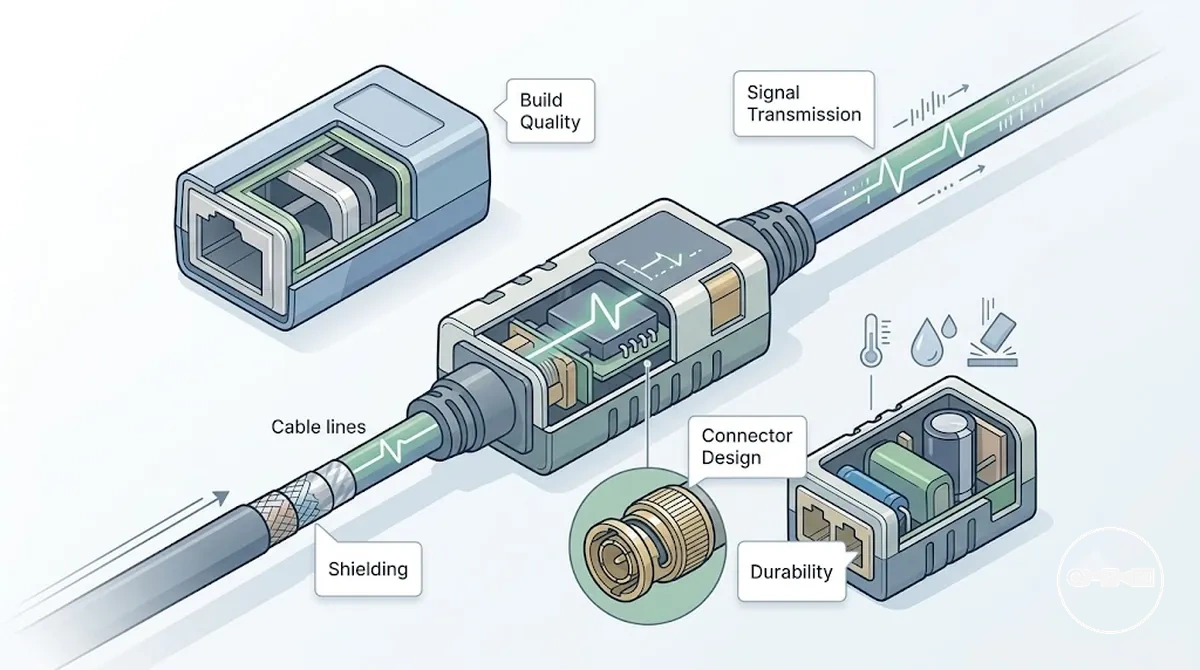
Build quality is one of the primary cost factors, as higher-grade materials and more stable construction can improve long-term durability and reduce performance degradation under continuous use. Signal transmission capability also influences cost structure because designs that support more stable or extended transmission conditions often require more refined internal engineering. Shielding quality affects how well the signal adapter resists interference, and this can vary depending on installation scenario conditions such as cable environment or electromagnetic exposure. Connector design also contributes to pricing differences, since more secure or compatible connection structures may require additional precision in manufacturing. Each of these factors contributes differently to overall cost structure depending on how the CCTV system is configured.
From a broader value evaluation perspective, CCTV video balun pricing reflects how these combined factors influence reliability and lifecycle performance under real installation conditions. When compatibility requirements increase across different cable types, the cost structure may shift to accommodate more stable signal handling. Installation scenario complexity can also affect how much emphasis is placed on durability versus basic functionality. In this way, cost factors work together as a system that defines both immediate performance expectations and long-term operational stability of the signal adapter.
Active vs Passive CCTV Video Balun Price Differences and Cost Impact
Active vs passive CCTV video balun pricing is based on differences in internal signal processing methods and how those methods influence cost-performance outcomes in CCTV installations. The comparison centers on how active designs introduce signal processing capability that can affect CCTV video balun pricing through higher component complexity, while passive designs rely on simpler signal handling structures that typically align with lower cost structures. These differences in cost factors are directly linked to how each type manages signal transmission under varying installation scenarios and compatibility conditions. In many cases, value evaluation depends on whether the installation requires extended transmission support or short-range simplicity.
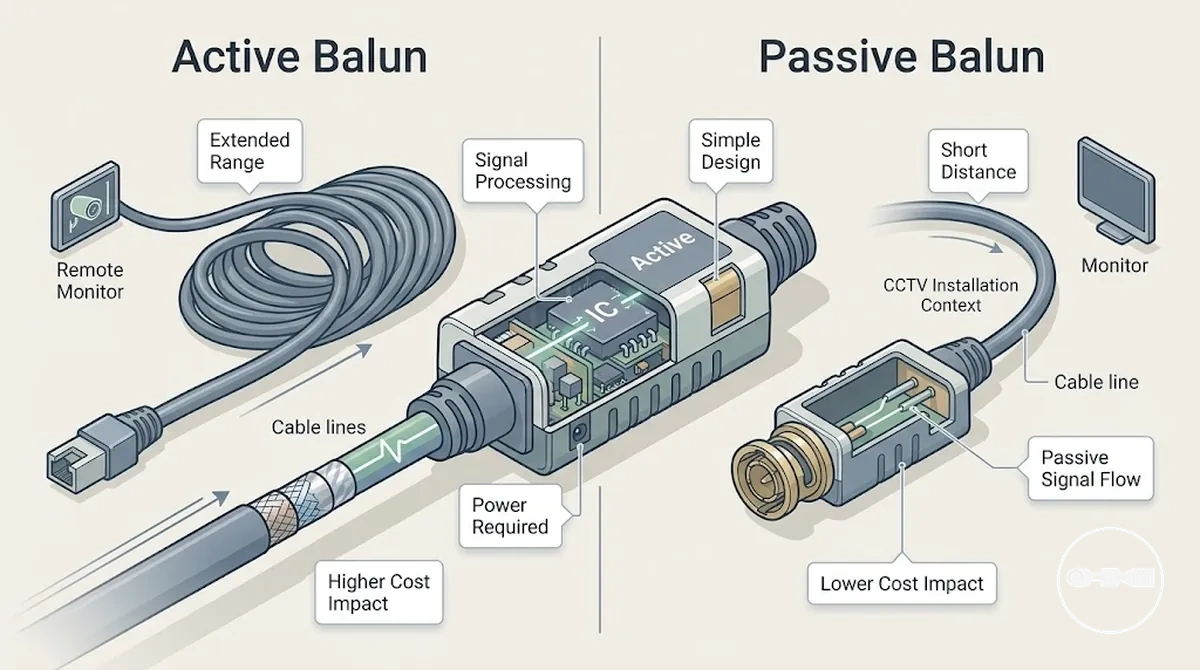
Active CCTV video baluns typically involve signal processing or amplification elements that can increase manufacturing complexity, which may contribute to higher cost structures. This processing can support more stable signal transmission over longer distances when installation scenarios require extended reach, although actual performance depends on system configuration and compatibility conditions. Passive CCTV video baluns use simpler internal structures without signal amplification, which generally aligns with lower cost factors and simpler deployment requirements. Their suitability is often more aligned with short-distance installation scenarios where minimal processing is sufficient.
From a value evaluation perspective, CCTV video balun pricing differences between active and passive types reflect a trade-off between processing complexity and installation requirements. Active designs may align with higher cost factors when extended signal transmission capability is needed, while passive designs may align with cost efficiency in simpler setups. The selection between these types depends on installation scenario constraints, compatibility needs, and the required balance between signal transmission performance and overall system cost structure.
CCTV Video Balun Price Ranges and Market Comparison
CCTV video balun price ranges are structured in tiers based on specification level rather than fixed pricing, where internal design, signal capability, and build quality determine how each unit is positioned in the market. This tier-based comparison uses an EAV logic where factors such as resolution support and component complexity influence manufacturing cost and ultimately define price range positioning across different balun categories.
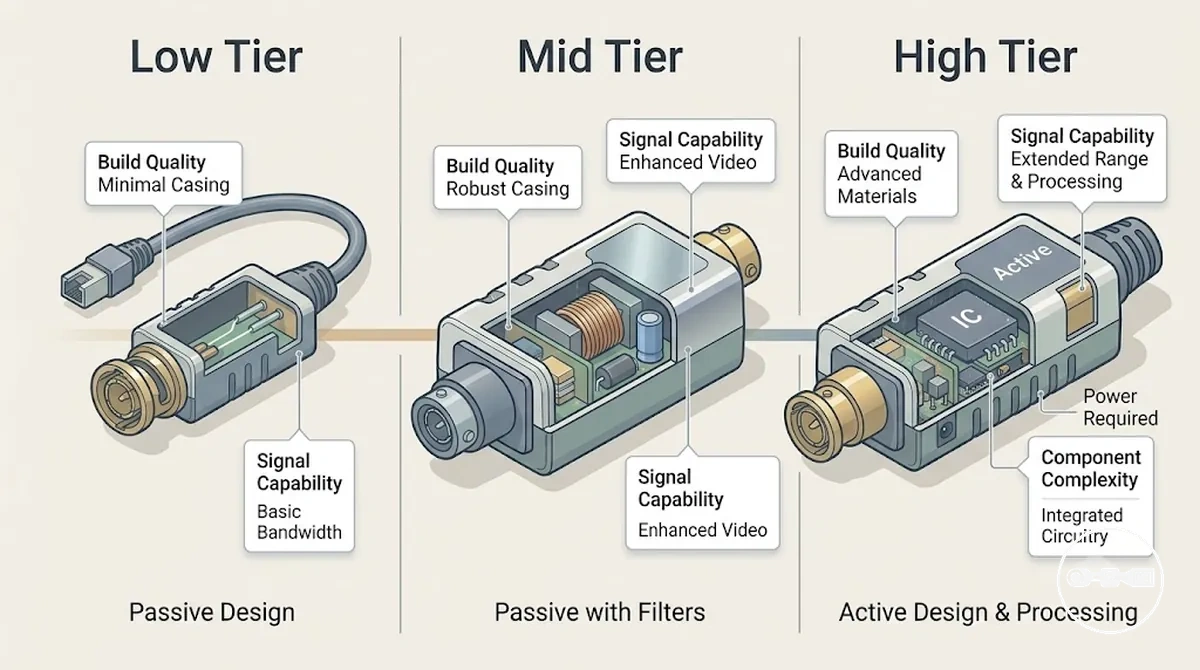
Low-tier CCTV video baluns are defined by simpler internal construction and basic signal handling structures. These units typically align with short-distance installations where minimal processing is required, resulting in lower component complexity and reduced manufacturing cost factors. Their market position reflects functional adequacy for basic CCTV setups rather than extended performance demands.
Mid-tier CCTV video baluns introduce improved build consistency and more stable signal handling compared to entry-level designs. Differences in shielding quality, connector precision, or material grade can increase internal complexity, which may place these units in a moderate pricing range. They are often used in installations requiring balanced performance across medium transmission distances and varied compatibility conditions.
High-tier CCTV video baluns are associated with more advanced internal engineering that supports stronger signal stability and broader installation flexibility. Higher material standards and more complex internal structures can increase manufacturing cost factors, which positions these units in higher price ranges. Although externally similar to lower tiers, internal design differences often account for significant variation in market pricing and performance capability.
CCTV Balun Quality Indicators and Features That Affect Cost and Value
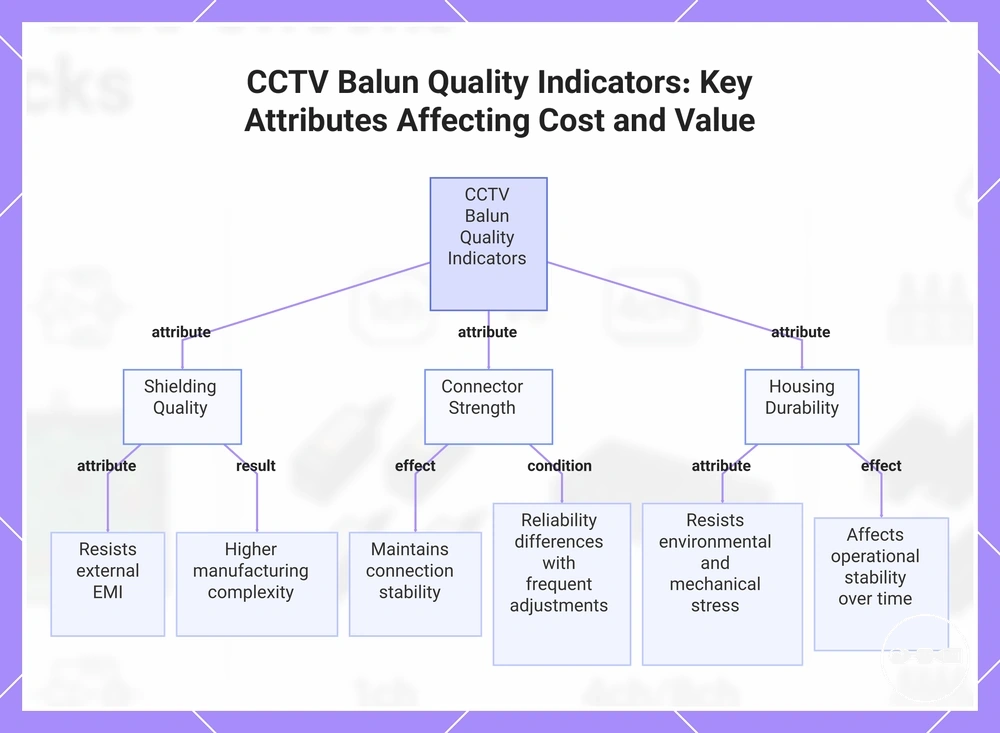
Balun quality indicators define the measurable structural and performance attributes that determine how reliably a CCTV video balun can maintain signal stability under different installation conditions. These indicators influence both pricing and long-term value by linking internal design characteristics to real-world transmission behavior rather than standalone specifications.
Shielding quality is a primary quality indicator because it affects how effectively the balun resists external electromagnetic interference during signal transmission. Improved shielding design can reduce noise sensitivity and support more stable signal behavior, which typically corresponds with higher material and manufacturing complexity. In many installations, the impact becomes more relevant when cable runs are longer or environments contain higher interference sources.
Connector strength is another key attribute that defines how consistently signal continuity is maintained between the camera and transmission line. Variations in connector construction, material quality, and mechanical fit can influence connection stability during installation or maintenance cycles. This factor contributes to reliability differences, especially when systems are frequently adjusted or reinstalled.
Housing durability refers to the structural resistance of the balun’s outer casing against environmental and physical stress. Material selection and casing design may affect resistance to heat, moisture, and mechanical pressure, which in turn influences operational stability over time. Alongside this, signal stability performance reflects how consistently the device maintains transmission quality across varying conditions, integrating all other quality indicators into overall functional behavior.
This chart shows the main balun quality indicators—shielding quality, connector strength, and housing durability—and how they influence performance and cost.
Compatibility Requirements That Influence CCTV Video Balun Pricing (HD Formats and Cable Types)
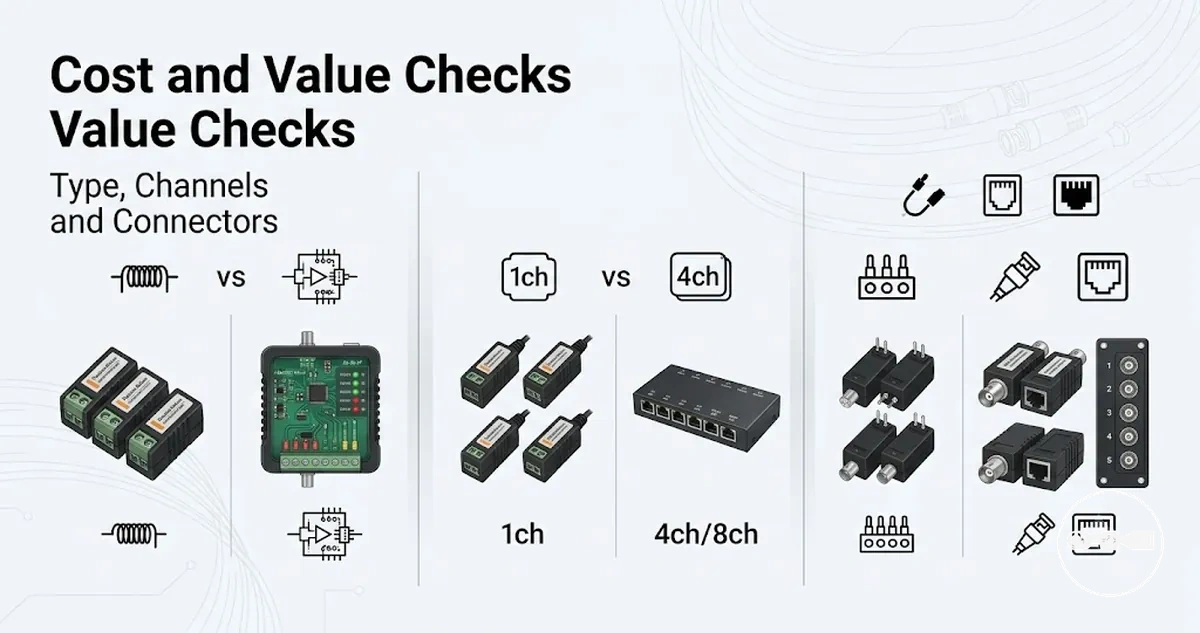
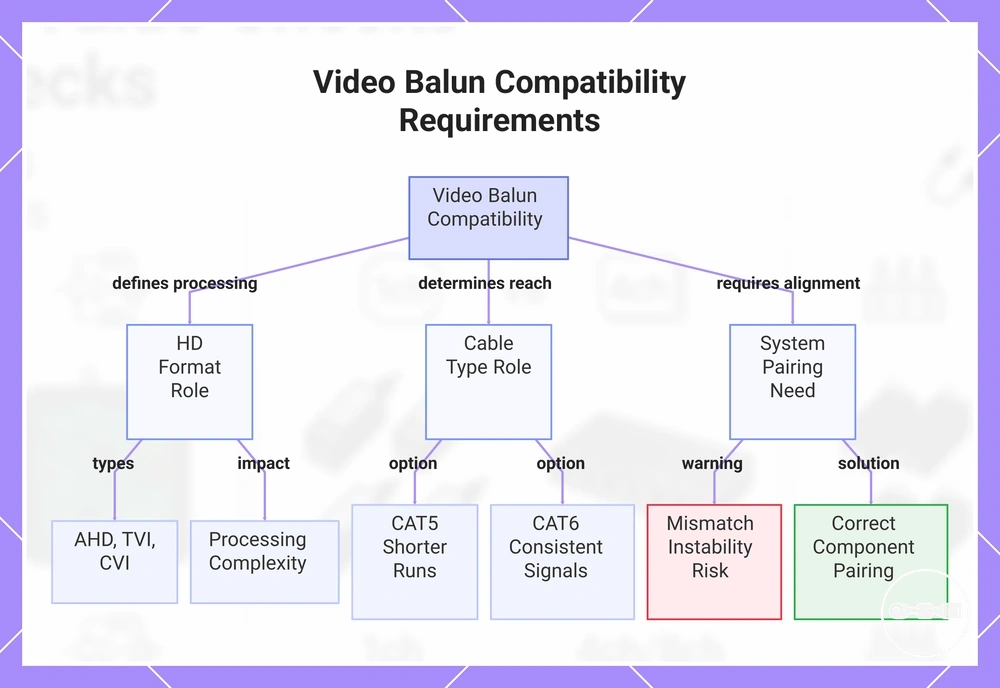
CCTV video balun compatibility requirements determine suitability and constraints by defining how HD formats such as AHD, TVI, and CVI interact with transmission hardware and how cable types such as CAT5 and CAT6 influence signal handling performance. These compatibility relationships affect selection complexity because each signal format may require different internal processing behavior, which can influence hardware design and overall system configuration.
AHD, TVI, and CVI formats each carry different signaling characteristics that can impact how a balun processes and stabilizes video transmission. In many cases, higher processing needs may correspond to increased internal circuit complexity, which can contribute to variations in hardware configuration depending on the supported format range. However, actual compatibility may depend on system pairing between camera output and receiving equipment, rather than format alone.
CAT5 and CAT6 cable types also influence compatibility decisions by shaping transmission stability, distance behavior, and interference sensitivity. CAT6 may support more consistent signal conditions in certain structured installations, while CAT5 may be used in shorter or less demanding setups depending on system design. These differences can affect how the balun maintains signal integrity across varying installation environments.
Overall selection complexity increases when HD format requirements and cable infrastructure must align simultaneously with balun processing capability. Compatibility mismatches may lead to reduced signal stability or limited installation flexibility, so correct pairing between format, cable type, and hardware capability is typically required to achieve stable performance outcomes under varying conditions.
This chart shows the two main factors defining CCTV video balun compatibility: HD formats and cable types, and the critical requirement for correct system pairing to ensure stable performance.
Channel Count and Kit Configuration Cost Implications
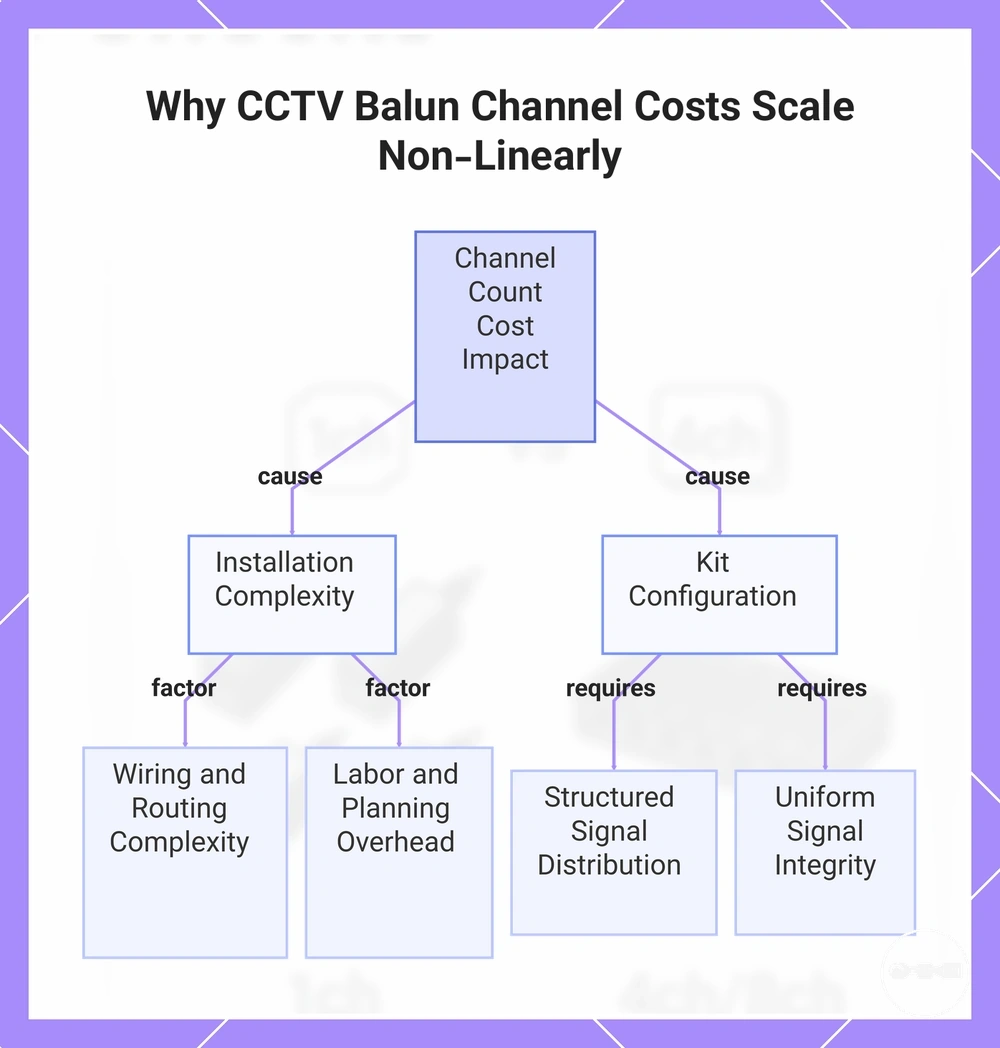
Channel configuration in CCTV video balun systems does not scale in a strictly linear way, because increases in channel count affect installation structure, wiring density, and system coordination requirements rather than only multiplying individual units. This scaling behavior means that cost impact is shaped by system complexity instead of simple per-unit expansion.
As channel density increases, installation complexity typically grows due to additional wiring paths, signal routing requirements, and physical organization of connections. These factors can introduce more labor involvement and planning overhead, which may influence total system cost beyond the hardware quantity alone.
Kit configurations also affect cost behavior because bundled multi-channel setups often require more structured signal distribution and consistent performance across multiple endpoints. In such cases, material scaling is influenced not only by the number of channels but also by the need to maintain uniform signal integrity across the entire system layout.
Higher channel counts therefore increase channel density, which can elevate installation complexity and drive material scaling requirements. This results in non-linear cost behavior where total system cost may vary based on how channels are distributed and configured, rather than following a direct unit-based calculation.
This chart explains the factors that cause non-linear cost behavior in CCTV video balun systems as channel count increases, focusing on installation complexity and kit configuration.
Bulk Purchasing vs Single Units: Pricing Structure and Savings Opportunities
Purchasing strategy depends on how order volume influences unit economics and total system cost, where bulk and single-unit procurement create different cost behaviors based on scale rather than fixed pricing rules. The relationship between purchase volume and pricing affects both unit cost efficiency and how deployment planning is structured across installations.
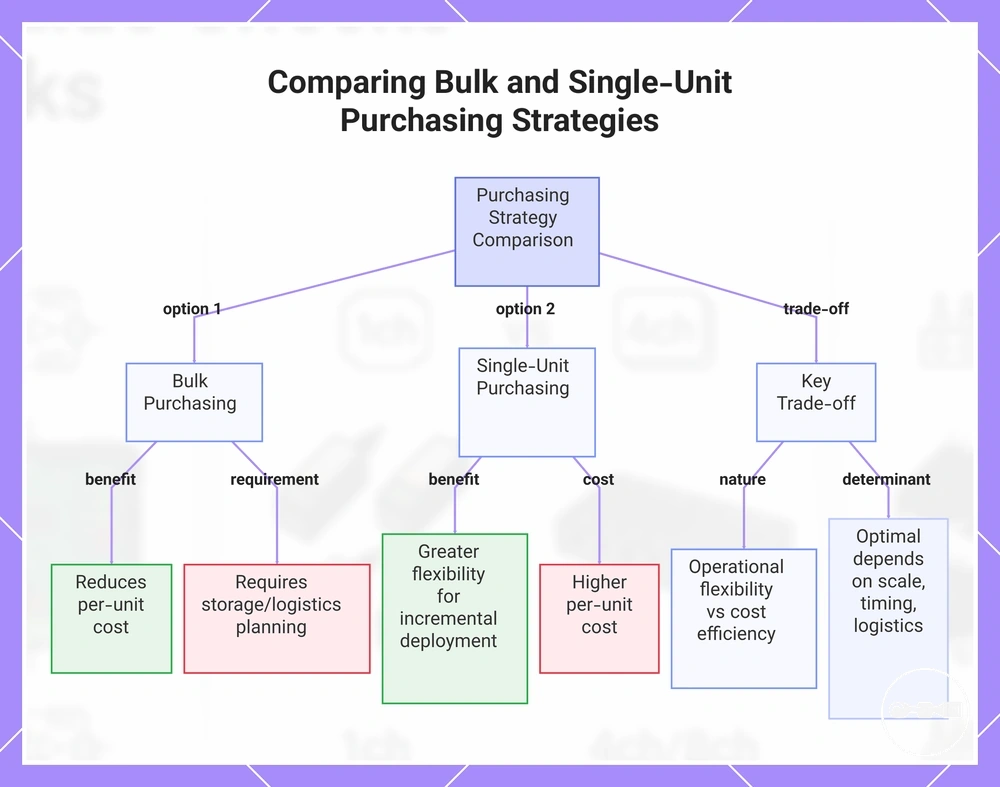
Bulk purchasing can reduce per-unit cost because higher order volumes distribute procurement and handling effort across more units. This creates a scale effect where purchase volume → per-unit cost reduction → improved cost efficiency, although actual savings may vary depending on supplier structure and project requirements. However, this approach may require additional planning for storage capacity and staged installation logistics.
Single-unit purchasing provides greater flexibility for incremental deployment and system expansion, especially when installation requirements are not fixed in advance. While per-unit cost is usually higher than bulk orders, this approach can reduce inventory exposure and support more precise alignment with changing project needs. The trade-off typically lies between operational flexibility and aggregated cost efficiency.
At the system level, purchasing strategy affects overall cost behavior through volume scaling, coordination effort, and savings potential. In many cases, the optimal approach depends on installation scale, timing, and logistical constraints rather than a universal advantage of either method. :contentReference[oaicite:0]{index=0}
This chart compares bulk purchasing and single-unit purchasing, highlighting their key benefits, trade-offs, and the factors that determine the optimal strategy.
Assessing Value: When Higher Cost Improves Performance and Long-Term Reliability
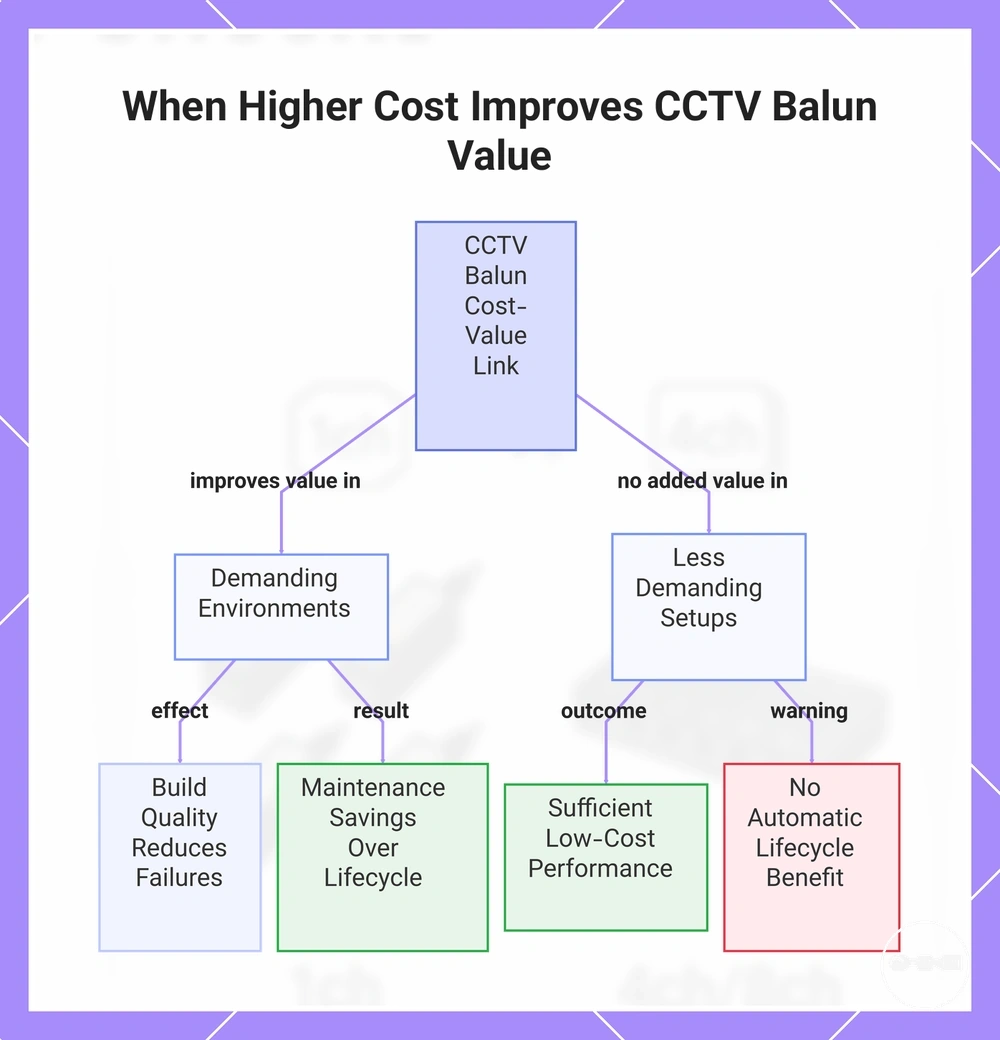
Higher cost in CCTV video balun systems depends on whether improved build quality translates into measurable lifecycle benefits such as reliability, durability, and reduced maintenance under specific installation conditions. The cost vs value relationship is not fixed, since performance gains are often tied to environmental stress levels and system demands rather than price alone.
In demanding environments, premium construction materials and more stable internal design may contribute to reduced failure rates. This can influence system stability by lowering the likelihood of signal degradation or connection issues, especially in installations exposed to interference or long transmission distances. In such cases, build quality → failure reduction → maintenance savings becomes a relevant evaluation chain.
From a lifecycle perspective, reduced maintenance needs can improve operational efficiency over time, shifting value from upfront savings toward long-term cost stability. However, this outcome depends on installation context, system scale, and compatibility with existing infrastructure, meaning higher cost does not automatically guarantee better lifecycle performance.
Therefore, higher cost may improve overall value when environmental conditions or operational demands justify stronger durability requirements. In less demanding setups, lower-cost options may still provide sufficient performance without additional lifecycle benefits, making value assessment context-dependent rather than price-driven. :contentReference[oaicite:0]{index=0}
This chart shows how higher cost can improve value in CCTV balun systems depending on installation environment and system demands, and when lower-cost options remain sufficient.