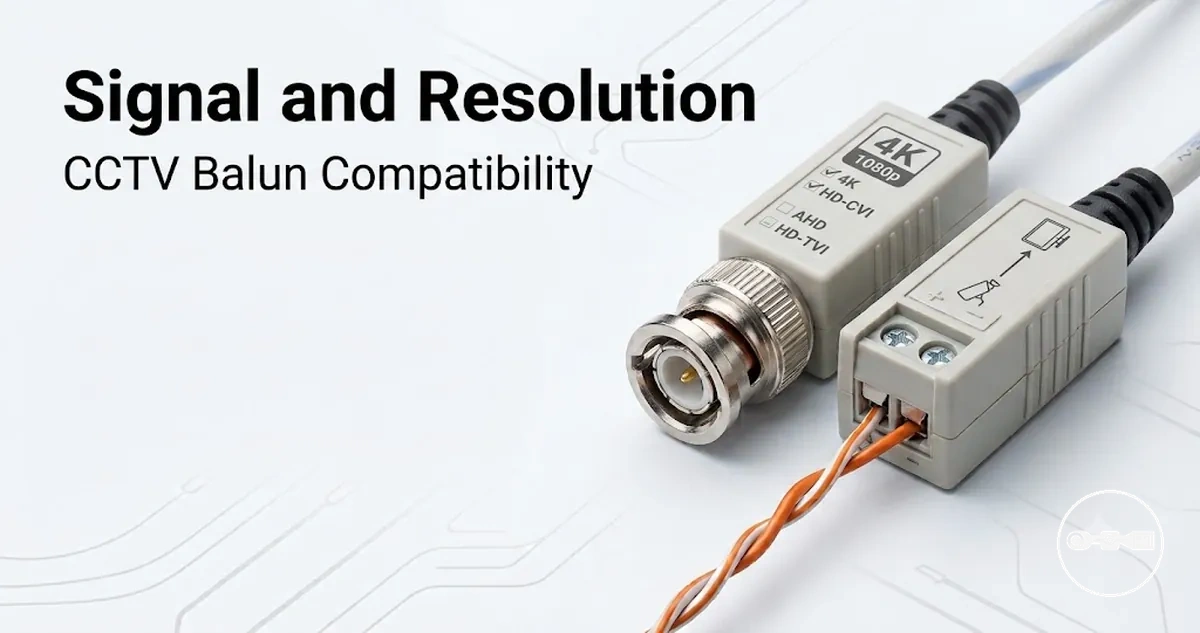
CCTV Video Balun Signal Format and Resolution Compatibility
CCTV Video Balun Signal Format and Resolution Compatibility refers to system-level alignment between balun behavior, signal format, resolution stability, and transmission conditions. It depends on how CCTV system components interact across cable distance, environmental noise, and format signaling behavior conditions. Compatibility emerges when balun transmission preserves signal format integrity while maintaining resolution stability under HD-over-coax conditions. Any mismatch in impedance, format interpretation, or transmission quality may reduce clarity and shift compatibility outcomes toward signal degradation.
Signal format and resolution behavior are tightly linked within CCTV transmission chains using baluns under varying installation conditions. They influence each other because resolution stability depends on how signal format is encoded, transmitted, and preserved across cable and connector pathways. HD-over-coax formats such as AHD, TVI, and CVI may respond differently to noise levels, impedance variation, and cable distance conditions. These variations mean compatibility must be evaluated as a full system property rather than isolated device capability or single component performance alone. To understand system boundaries and broader compatibility context, it helps to relate these interactions to the wider balun category framework CCTV video baluns overview.
CCTV Video Signal Formats Supported by Video Baluns Across Analog, HD, AHD, TVI, and CVI Systems
CCTV video signal formats supported by video baluns represent compatibility-defining parameters that determine how transmission behaves across system components and cable conditions. These formats influence how baluns interact with CCTV system signaling paths, affecting resolution stability under varying transmission conditions. Compatibility depends on how signal format behavior aligns with impedance alignment and signal integrity across connected devices and cabling. In many cases, baluns act as adaptation points where format behavior meets physical transmission constraints before further interpretation in downstream systems.
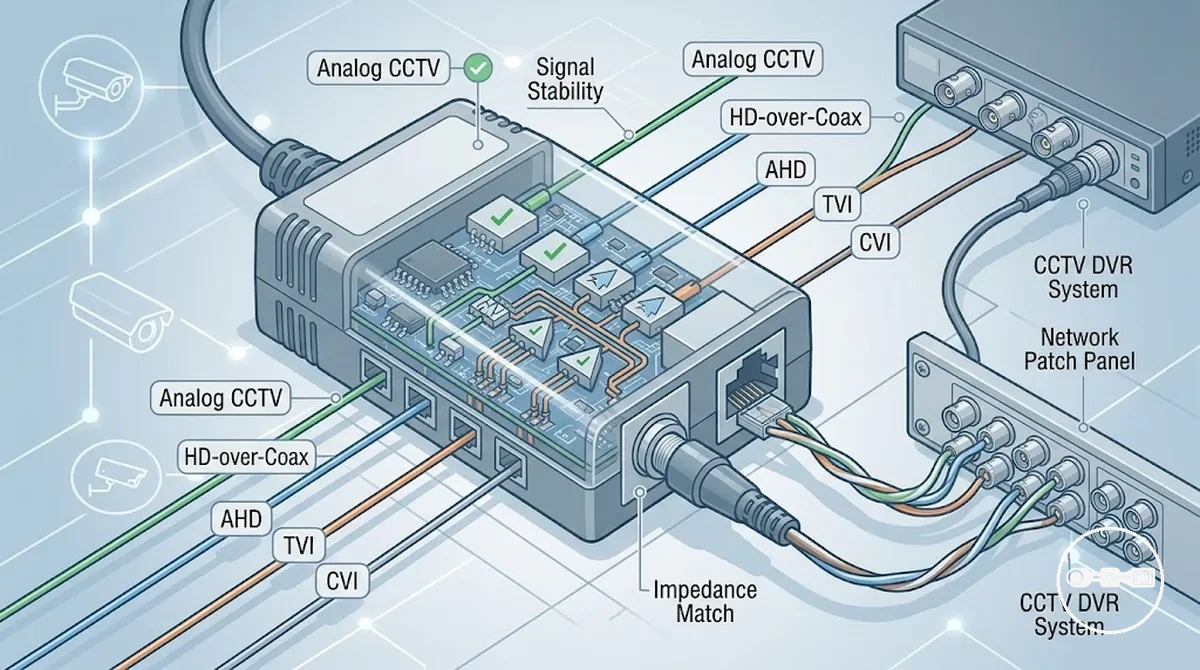
Signal format behavior in analog CCTV and HD-over-coax systems such as AHD, TVI, and CVI varies based on how each standard maintains signal integrity through balun transmission paths and cable environments. Analog CCTV formats typically respond more directly to impedance alignment and installation sensitivity, where small inconsistencies in cabling may influence clarity and stability. HD-over-coax formats like AHD, TVI, and CVI tend to preserve higher resolution behavior but remain dependent on signal format quality and transmission conditions across the full CCTV system chain. Analog vs HD-over-coax contrast: analog systems prioritize simpler signal structures while HD-over-coax formats rely on tighter synchronization between encoding and transmission stability under balun conditions. These differences become more pronounced when evaluated alongside balun behavior variations, which can be further related to selection differences in active and passive baluns, especially when installation sensitivity and cable conditions vary across deployments.
Resolution Transmission Capability of CCTV Video Baluns from Standard Definition to 4K Transmission
Resolution transmission capability of CCTV video baluns depends on signal integrity across the full CCTV system transmission path and installation conditions. SD, HD, and 4K transmission behavior is determined by resolution stability, attenuation levels, noise interference, and overall signal integrity conditions in installed systems. Higher resolution outputs require stronger signal integrity because attenuation and noise more easily degrade HD-over-coax performance over longer cable distances. CCTV balun performance therefore varies across installations, where resolution stability depends on impedance alignment, cable quality, and environmental constraints overall.
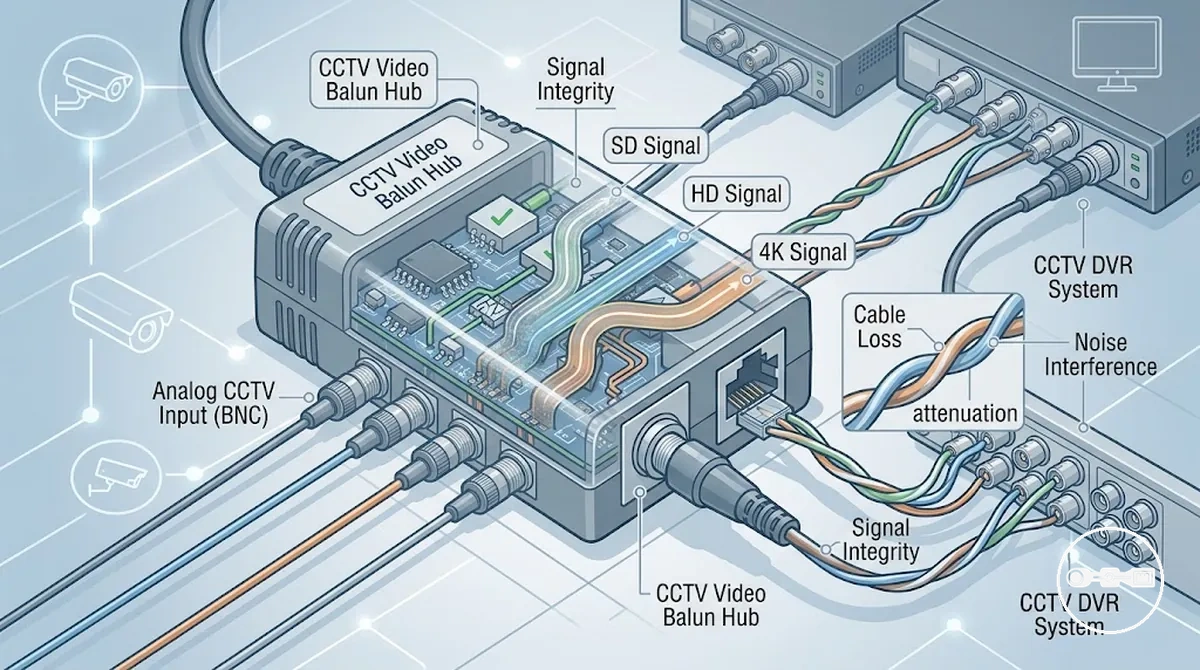
Resolution behavior across SD, HD, and 4K levels varies significantly depending on cable quality, attenuation, noise, and signal integrity conditions. SD signals typically remain more tolerant to degradation, while HD and 4K transmissions show higher sensitivity to attenuation and interference effects. Signal integrity in balun-based CCTV systems plays a central role in maintaining resolution stability under variable noise and distance conditions. Impedance alignment issues can increase signal loss, which reduces HD-over-coax clarity more noticeably than standard analog CCTV transmission setups conditions. Higher resolution formats require more stable transmission conditions, especially when cable loss and noise levels increase across longer installations. Key diagnostic factors influencing resolution performance can be summarized across practical installation conditions affecting balun transmission behavior consistently and system-wide analysis contexts.
- Cable quality impact on signal integrity and attenuation levels
- Noise interference affecting HD and 4K transmission stability
- Impedance alignment consistency across balun connections
- Distance-related signal loss influencing resolution stability
- System condition variability across SD, HD, and 4K setups
Compatibility Between CCTV Video Baluns, Cameras, and DVR Encoding Systems
Compatibility Between CCTV Video Baluns, Cameras, and DVR Encoding Systems defines system-level alignment across camera output, balun transmission behavior, and DVR encoding processing stages. System compatibility depends on continuous signal chain integrity where camera output, balun impedance matching, and DVR decoding format alignment remain consistent across devices. Any mismatch in impedance or encoding format can disrupt signal chain continuity, reducing compatibility and causing distortion or partial signal loss conditions. Mixed CCTV setups may still operate under partial compatibility conditions, but performance stability varies depending on installation quality, distance, and noise levels.
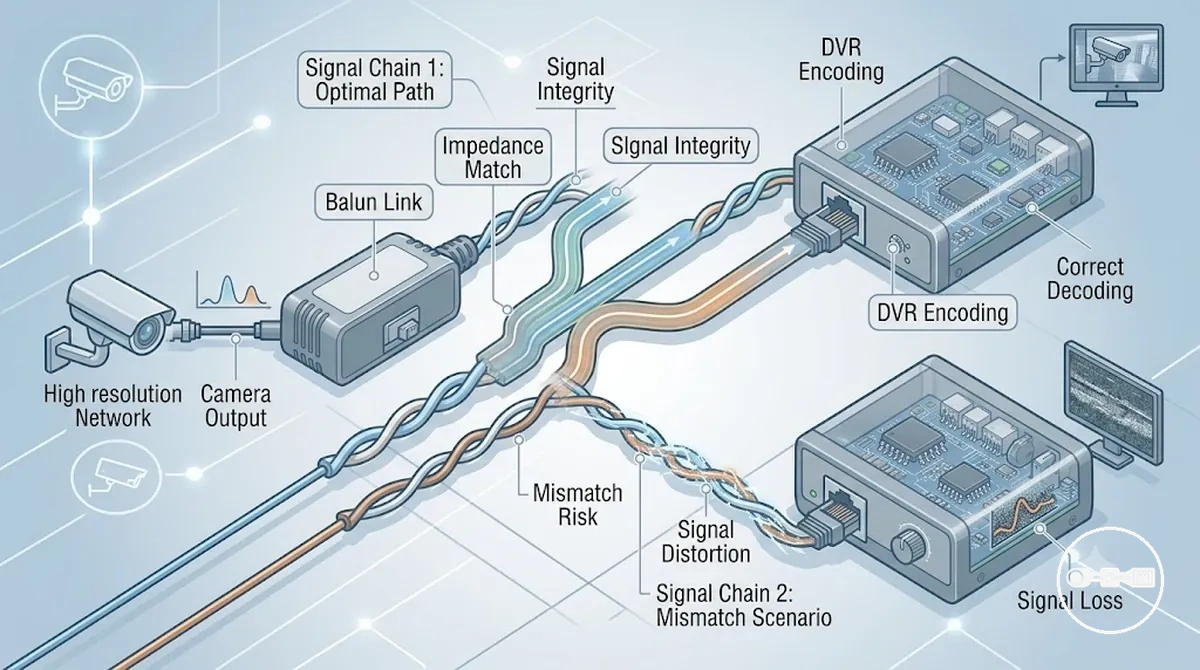
Signal chain compatibility between cameras, baluns, and DVR encoding systems determines whether video is correctly transmitted, decoded, and displayed without distortion. When camera output format or DVR encoding standards do not align, signal loss, impedance mismatch, and video distortion often occur across transmission paths. Balun transmission behavior acts as a bridging stage in the signal chain, and inconsistencies can amplify noise or weaken resolution stability. Partial compatibility may occur in mixed installations, but performance depends on full signal chain alignment. Diagnostic mismatch conditions can be summarized as follows:
- Camera output format inconsistency
- DVR encoding mismatch
- Impedance misalignment in balun connection
- Excess cable attenuation and noise interference
- Signal chain instability across long distances
How Cable Distance and Transmission Conditions Affect Resolution Stability in CCTV Video Balun Setups
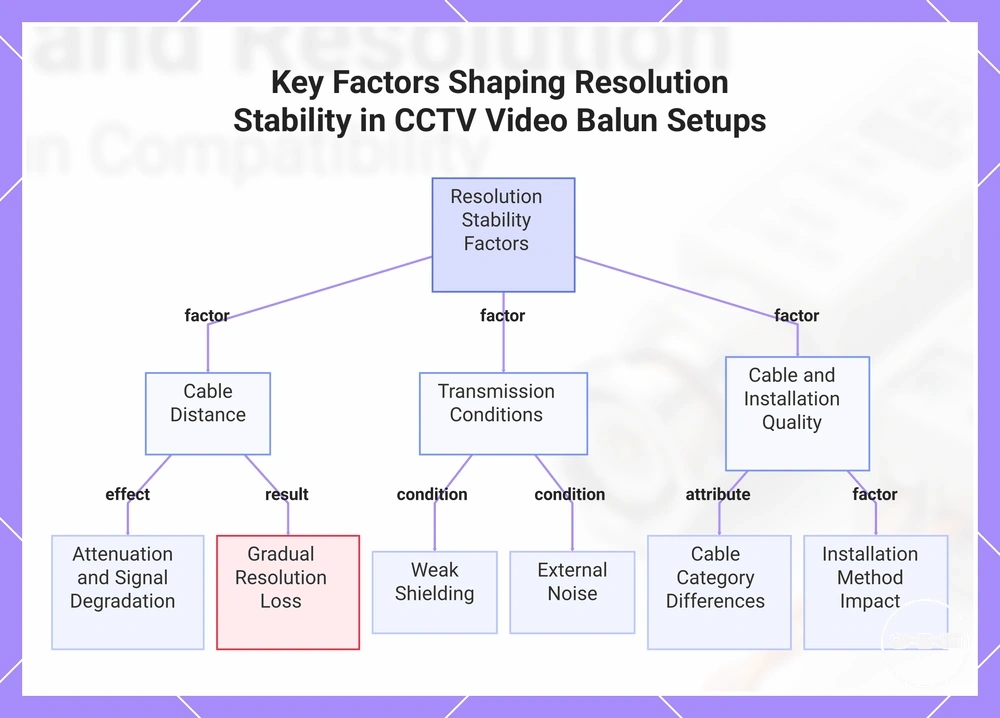
Cable distance directly influences resolution stability in CCTV video balun setups because longer transmission paths increase attenuation and signal degradation. As distance increases, the video signal becomes weaker, which can reduce resolution stability under real installation conditions. This weakening often appears as gradual resolution loss rather than an immediate failure, depending on system quality. Noise levels introduced along the cable path can further intensify signal degradation and affect image consistency.
Resolution stability is primarily shaped by a combination of cable category, shielding quality, installation environment, and overall transmission conditions. Higher attenuation is typically observed when shielding is weak or when external electrical noise interferes with the signal path, increasing the risk of resolution loss. Cable performance varies significantly depending on material quality and installation method, especially when balancing distance and signal integrity. The relationship between these factors and system behavior is often analyzed using cable and distance factors, where better cable construction can help reduce signal degradation under controlled conditions. Even so, performance remains variable rather than fixed, and outcomes depend on the full installation environment.
Key factors affecting resolution stability in balun-based CCTV systems can be summarized as follows:
- Cable distance impact on attenuation and signal degradation
- Shielding effectiveness in reducing noise interference
- Cable category differences affecting transmission quality
- Installation environment influencing external signal disruption
- Accumulated resolution loss due to weak signal integrity
This chart shows the main factors—cable distance, transmission conditions, and cable/installation quality—that influence resolution stability in CCTV video balun setups, along with their specific effects and conditions.
Signal Mismatch and Format Incompatibility in CCTV Video Balun Installations
Signal mismatch in CCTV video balun installations refers to a breakdown in signal behavior where camera output, balun transmission, and DVR decoding expectations do not align. This type of signal mismatch may occur due to format incompatibility, impedance differences, or resolution handling gaps across connected components. In some cases, multiple weak points in the signal chain combine and produce instability rather than a single identifiable fault. As a result, distortion, no video, or intermittent loss can appear depending on how the system is configured and installed.
These conditions are typically observed through system behavior rather than a single diagnostic cause. A mismatch between camera output format and DVR encoding capability can lead to decoding errors that may appear as frozen frames or no video. Impedance irregularities in the transmission path can contribute to signal distortion or weakening, especially when combined with format incompatibility. In mixed failure scenarios, distortion and intermittent loss may occur together, reflecting multiple interacting issues rather than one isolated problem. Because of this variability, symptom interpretation must remain conditional and dependent on installation context and equipment interaction.
A structured diagnostic view helps relate observable symptoms to possible system-level causes without assuming a single failure point. Further troubleshooting patterns related to CCTV video balun issues can be referenced through troubleshoot poor video. The table below summarizes common symptoms and their possible interpretations in signal chain behavior.
| Symptom | Possible Cause | System Interpretation |
|---|---|---|
| No video | Severe format incompatibility or impedance disruption | Breakdown in signal chain between camera, balun, and DVR |
| Distortion | Partial format mismatch or signal degradation | Reduced signal quality affecting decoding accuracy |
| Intermittent loss | Variable impedance or unstable transmission conditions | Fluctuating signal mismatch across the transmission path |
| Frozen image | DVR decoding limitation or input format conflict | Encoding and decoding misalignment in signal processing |
Choosing the Correct CCTV Video Balun Based on Signal Format and Resolution Requirements
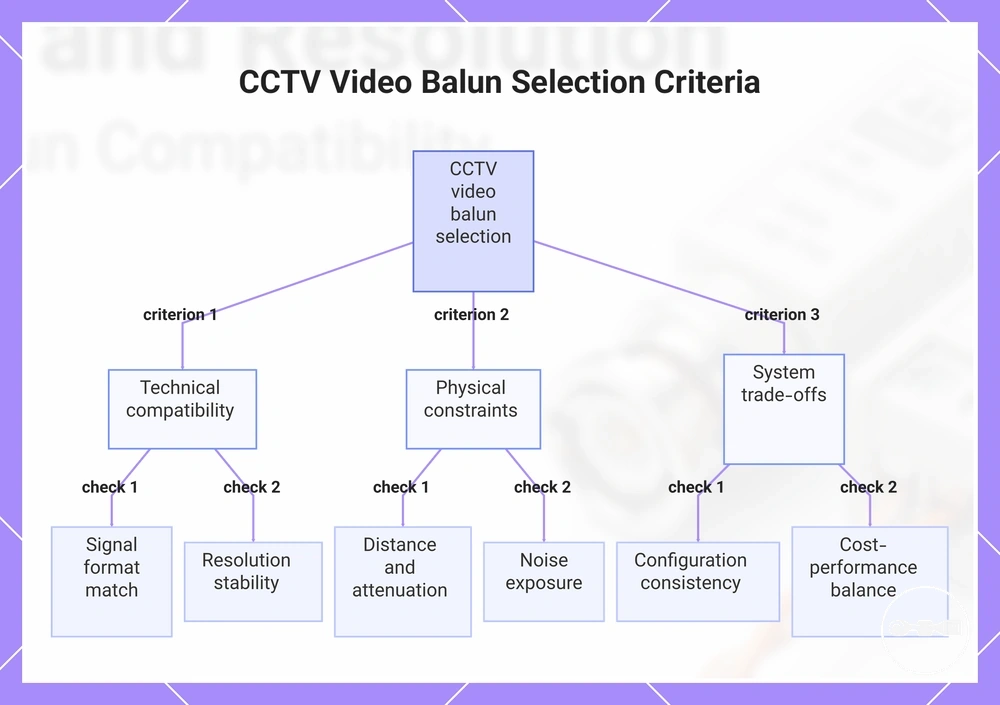
CCTV video balun selection criteria depend on signal format compatibility, resolution needs, distance constraints, and installation environment conditions. The selection process evaluates how effectively a balun can maintain signal integrity across different CCTV formats while supporting required resolution levels. In many cases, incorrect selection may result in reduced stability or inconsistent transmission behavior rather than complete failure. Therefore, decision-making must stay focused on system-level compatibility rather than isolated device features.
Trade-offs in CCTV video balun selection often occur between cost, performance stability, and format compatibility across the full signal chain. Higher resolution needs usually require stronger transmission stability, especially when distance constraints introduce attenuation effects. Installation environment conditions such as electrical noise or cable routing complexity can further influence compatibility outcomes. A structured selection checklist helps align technical requirements with deployment conditions by organizing key selection criteria into measurable decision points.
The following checklist outlines core evaluation points used to guide selection decisions based on system requirements and operating conditions:
- Signal format compatibility between camera and DVR systems
- Resolution requirements aligned with transmission stability needs
- Distance constraints and expected attenuation levels
- Installation environment and noise exposure conditions
- System-wide configuration consistency across components
Cost considerations influence selection outcomes by shaping the balance between performance requirements and deployment constraints. Lower-cost options may meet basic compatibility needs but can introduce limitations in resolution stability under extended distance conditions. Higher-cost configurations may provide improved stability across more demanding environments and longer transmission paths. A structured evaluation of cost and value factors supports clearer alignment between budget decisions and performance expectations.
This chart outlines the key selection criteria for CCTV video baluns, covering technical compatibility, physical constraints, and system trade-offs.